


A couple of weeks ago, my oldest son broke his arm in a lacrosse game. This was his first broken bone. We had been through another injury with him before, so it wasn’t the first time I had seen him in intense physical pain, but I still wasn’t accustomed to seeing this boy, who tends to be pretty tough, hurting long afterward.
And beyond the physical pain, he is also moving through some pretty significant life changes. Graduating middle school. Moving on to a new school. Leaving behind friendships that have shaped him since kindergarten. I don’t know exactly what is happening inside of his head because, from what I can tell, fourteen-year-old boys don’t exactly volunteer every thought and feeling that crosses their mind. So some of this is probably me making up stories about what could be happening for him.
Maybe that’s part of why this season feels so tender for many parents. It’s often jokingly called “Maycember,” but underneath the humor is a real accumulation of transitions, endings, decisions, and emotional movement arriving all at once.
We had scheduled his surgery for a few days after the injury, and I had cleared my calendar of clients. But it turned out the doctor wanted to push it back, so suddenly I had him at school and myself with an unexpected free day.
I had intended to use my time wisely. Catch up on projects. Work ahead. Do all the things that make me feel better because I’m checking off the boxes.
But when I sat down to work, there was absolutely no creativity available. My body felt heavy. Even folding laundry felt like making a decision about some world event.
I was talking about this with my friend on our run over the weekend. She remembered the same heavy, slowed-down feeling after her own daughter broke her arm and again after last year’s tornadoes in St. Louis; the body still slow long after the mind thinks it should move on.
Because I had cleared my schedule that Tuesday, I was privileged enough that I could honor what was being asked.
I took a nap. I watched a show. I went for a walk at what could only be described as a “sloth pace.”
But I can remember so many other moments before this where I pushed through instead. I made myself write the article. I ignored the exhaustion. I resisted what was here because there was such a strong internal pressure insisting this should not be happening.
So there was the weight of the actual fatigue, but there was also the additional weight of believing the fatigue itself was somehow wrong.
The Exhaustion Beneath the Exhaustion
I often wonder about the consequences of constantly abandoning what the body is requesting. Maybe at one end, it simply leaves us a little more irritable, tired, or disconnected. And at the other end, after years of pushing through and overriding those signals, perhaps it contributes to burnout, exhaustion, and dis-ease.
Some people become incredibly skilled at overriding themselves. They build endurance for it.
It’s always interesting when I’m talking with a client about stress and she says, “I’m really not that stressed. I’m just doing what most people do.” But then she walks me through an ordinary Tuesday that includes waking before dawn, managing children, rushing through work demands, coordinating schedules, carrying emotional labor for multiple people, and trying to hold everything together for everyone around her. (Oh, that’s me, too!)
And somewhere along the way we decided this level of constant sympathetic activation was normal.
Most people are simply responding to what has been asked of them.

The Mind That Never Stops Commenting
But I know for myself there is also this internal narrator constantly commenting, reminding, anticipating.
What are you making for dinner?
You forgot to sign that permission slip.
You still need to email that client back.
The mind rarely lets the body simply sit.
A person whose work I’ve been drawn to lately asked: Do we actually need thoughts to get things done, or do things mostly get done on their own?
Many of us carry this belief that if we stop mentally rehearsing life for even a moment, everything will fall apart. But more and more, I notice the opposite can also be true. Life unfolds, we move through it, and only afterward do we stitch together the story that we were fully in control all along.
It makes me wonder what would happen if the internal taskmaster loosened its grip just a little.
But I want to return to the deeper question underneath all of this: how do we know what we need?
Because yes, it could absolutely be argued that some people have more capacity to listen than others. A woman like myself, with a somewhat flexible schedule, could potentially reschedule a client if I truly needed to. A single mother working multiple jobs to make ends meet exists within a very different reality.
And still, I wonder if there are small moments available even there.
What does it look like when someone declines one more obligation because she already knows her calendar is full beyond capacity?
What does it look like when she feels fatigue moving through her body and allows herself to lie down for fifteen minutes, even though no one ever modeled for her that resting during the day was acceptable?
Our bodies were never meant to exist in fight-or-flight all day long.
Tiny Interruptions
Last year I attended a sleep workshop where the instructor encouraged us to pause throughout the day and do tiny, almost invisible movements. Gentle wrist circles. Small shoulder rolls. Brief moments of bringing attention back into the body and noticing what softened elsewhere when one small area relaxed.
Tiny interruptions to the momentum.
Little moments of asking: how is everything right now?
Sometimes I think it begins with something incredibly small. Looking at the plant in the office long enough to notice the veins in the leaves. Standing outside for one extra breath before getting in the car. Slowing down just enough to reestablish a different baseline inside ourselves.
Learning to Notice
Maybe this is the deeper practice underneath all of it. Not becoming perfectly rested or perfectly regulated or perfectly mindful. But becoming willing to notice.
To notice the heaviness before it becomes collapse.
To notice the tightening before it becomes illness.
To notice the subtle flinch in the body when we say yes but mean no.
And maybe even more radically, to respond.
Not every time. But enough to show ourselves that the world doesn’t fall apart when we ease up a bit.
I think many of us have learned to override ourselves so quickly that we no longer remember what life feels like without the constant hum of pressure underneath it. We call it productivity or responsibility or adulthood. We call it being needed. We call it success.
But underneath all of that there is often a body quietly asking for a different rhythm. A slower breath. A moment to simply catch up.
What would happen if we listened before the breaking point?
Maybe the goal is not becoming someone who never forgets a permission slip or perfectly optimizes every aspect of life. Maybe the goal is learning how to stay in relationship with ourselves while living an ordinary life.
To pause long enough to feel what is here.
To trust what we notice.
To let that noticing matter.
Menu for the Week of May 18-22nd
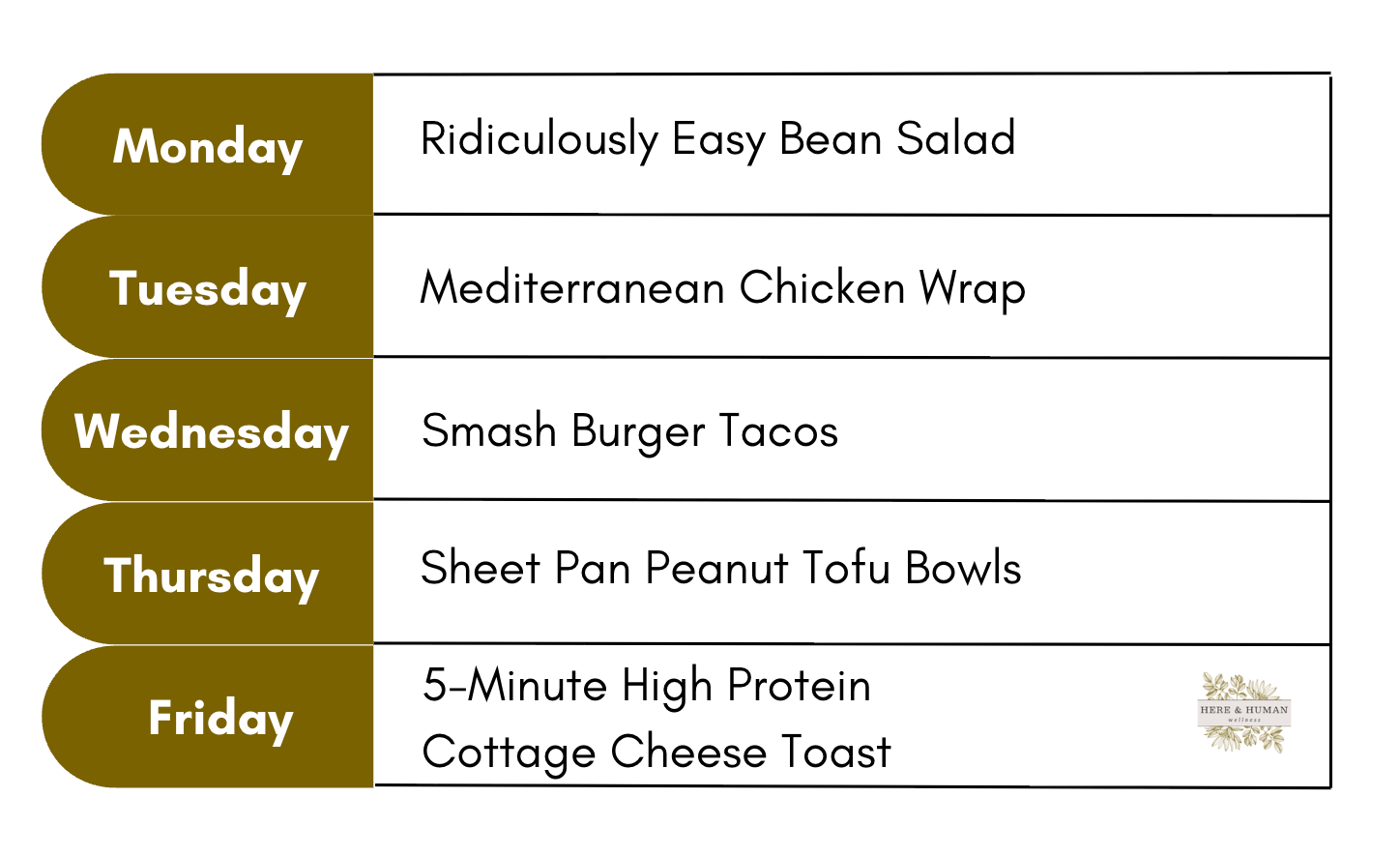
Quick poll! When I share recipes, do you want:
🥘 A little backstory + why I love it
OR
🔗 Just the link so you can get straight to the recipe?
Vote below 👇
Monday

Tuesday

Wednesday

Thursday

Friday
5-Minute High Protein Cottage Cheese Toast

XO - Jen