


For as long as I can remember, there have been messages, often packaged as health, improvement, or care, suggesting that something about our bodies needs to be changed. Long before we had language for nervous systems or internalized bias, we were absorbing a steady stream of cues about size, worth, and control.
Some of my earliest cultural markers were the green SnackWell boxes lined up in my childhood pantry: low-fat cookies so you don’t get fat. As a teen, I watched Oprah cycle through calorie-controlled plans and self-improvement frameworks, each one offering hope, discipline, and transformation. The formats changed, but the underlying message stayed remarkably consistent: thin equals better.
Diet trends have always come and go. But the current wave of GLP-1 medications is not a trend, it’s a medical intervention, amplified by relentless marketing, and it carries a different kind of psychological and emotional weight.
These ads are everywhere. And while advertising affects everyone differently, for people who already carry conditioning around body size, shape, weight, and worth, this messaging doesn’t land as neutral information. They can move straight into the body, activating stress responses, old narratives, and deeply embedded beliefs about control and value.
This isn’t just about physical health.
I follow a body-neutral writer on Substack, Virgie Tovar, and in a recent piece she offered language and research that helped name what so many people are experiencing (but maybe not noticing). Drawing on both data and lived experience, she describes what she calls “GLP-1 ad overwhelm”: a pattern of heightened anxiety, shame, and emotional dysregulation that can emerge from persistent exposure to GLP-1 marketing.
Reading her work put data around something I’ve been observing, not just in my clients, but in the cultural air itself.
A few of her findings were particularly striking:
Nearly everyone surveyed reported some degree of deterioration in body image after exposure to GLP-1 advertising.
About 40% reported a significant negative impact on their mental health.
Thirty percent shared that, on their most difficult days, these ads contributed to intense emotional dysregulation.
And more than 90% of respondents with histories of eating disorders or body image struggles said their sense of recovery felt at risk.
What stood out to me most was how sharply this contrasted with what I had been noticing just before these medications, and their marketing, entered the cultural mainstream. It felt as though concepts like intuitive eating, body neutrality, and Health at Every Size were finally gaining some traction. I was seeing it more on social media, in how dietitians were practicing, and even in how clients showed up to sessions - often saying some version of: weight loss matters, but so does my relationship with food and with myself.
As Virgie points out, when advertising leads to stress, emotional disruption, and threatens recovery, this isn’t just about a medication offering answers, it’s a public mental health issue.
A Personal (and Professional) Lens
As I’ve stated in other articles: I’m not anti-medicine, and I’m not anti-GLP-1s.
The Myth of “Managing” the Midlife Body

Women experience body changes throughout life, but in midlife, the tug-of-war between feeling at home in our bodies and feeling pressured to change them often becomes especially strong.
I’m grateful for science. I’m grateful for options. I’m grateful when people feel better in their bodies and their lives. And at the same time, I feel concerned by the growing assumption that this medication is the obvious, or inevitable, next step for anyone who has ever wished their body were different.
In my own practice, that assumption has started to change the emotional landscape of care.
It used to feel like people were playing with the same deck of cards. Sustainable health changes took time, but the process felt shared. Progress wasn’t fast, but it was understandable.
Now there’s a shiny ace on the table.
And of course, the mind starts asking:
What does it mean if I don’t want, or can’t access, this option?
Am I doing something wrong by choosing a slower, more effortful path?
Why does my progress feel so hard when others seem to change so quickly?
Can I trust that my well-being is still valid without taking this medication?
Will choosing this, or not choosing it, actually lead to the life I want long-term?
These questions make sense. Given the current landscape, it’s natural for the mind to become busy with mental chatter.
Three Things That Come Up To Support Ourselves
1. Feel It, Without Fixing It
When you see an ad or hear someone talk about their results, you might notice your chest tighten or your stomach drop. Judgmental or urgent thoughts may follow.
This isn’t a signal that you need to act. These reactions, including the mental noise, aren’t you. They’re conditioning.
Years of messaging that equate body size with worth live in the nervous system. When those messages get activated, sensations arise. Thoughts follow. That’s how bodies work.
You don’t need to argue with the thoughts or rush to make a decision. You can simply notice what’s happening inside you and stay with it. Discomfort is uncomfortable, but it’s survivable.
Thoughts will come. Yet thoughts don’t require action.
Often, when you come back to the body: to breath, sensation, direct experience, the noise begins to settle on its own.
2. Get Solid on Your “Why”
If you’re choosing not to use the medication right now, it can help to know why.
Maybe you don’t want to be on a medication long-term.
Maybe you tried it and it didn’t feel good in your body.
Maybe you prioritize muscle, bone density, and long-term health and trust the science that health can exist across a range of body sizes.
Your reason doesn’t have to convince anyone else. It just needs to be solid enough that when the noise gets loud, you have something to come back to.
3. Leave Room for “Not Now”
One thing I keep returning to, both personally and in my work, is the relief that comes from not turning any heavy thought into an all-or-nothing decision.
We can remember that seeing an ad or hearing someone else’s success story doesn’t require an immediate response.
What if your answer, for this time, is simply “not now?” Not now doesn’t mean never. Not now doesn’t mean closed-minded.
Just because you might fit “inclusion criteria” for this medicine doesn’t mean a choice has to be made. Sometimes the most supportive thing you can say to yourself is: I don’t have to decide this right now.
If You Set One Intention This Season
January is when diet culture is loudest. So many ads and programs on the ready to make us BETTER! And yet, biologically and emotionally, winter is a season of slowing down. Restoration. Rest. LESS striving.
What is the one intention for you that might feel this way?
For me, I’ve found myself in the mode of slow walks. And this quote from Outside Lies Magic says it all!
Get out now… Go outside, move deliberately, then relax, slow down, look around. Do not jog. Do not run. Forget about blood pressure and arthritis, cardiovascular rejuvenation and weight reduction… Walk. Stroll. Saunter… Explore.
It can be hard to do this when it’s cold outside, but I’m perfecting my winter walking wardrobe, and I’ve come to love walking early in the morning—when it’s dark and quiet. It’s where I feel most grounded, and where the next right steps tend to reveal themselves.
So if you set one intention this season, maybe it’s this:
Walk. Don’t run.
With your body.
With your decisions.
With yourself.
Nothing to rush. Nothing to fix.
Let choices unfold from stillness, with patience and care.
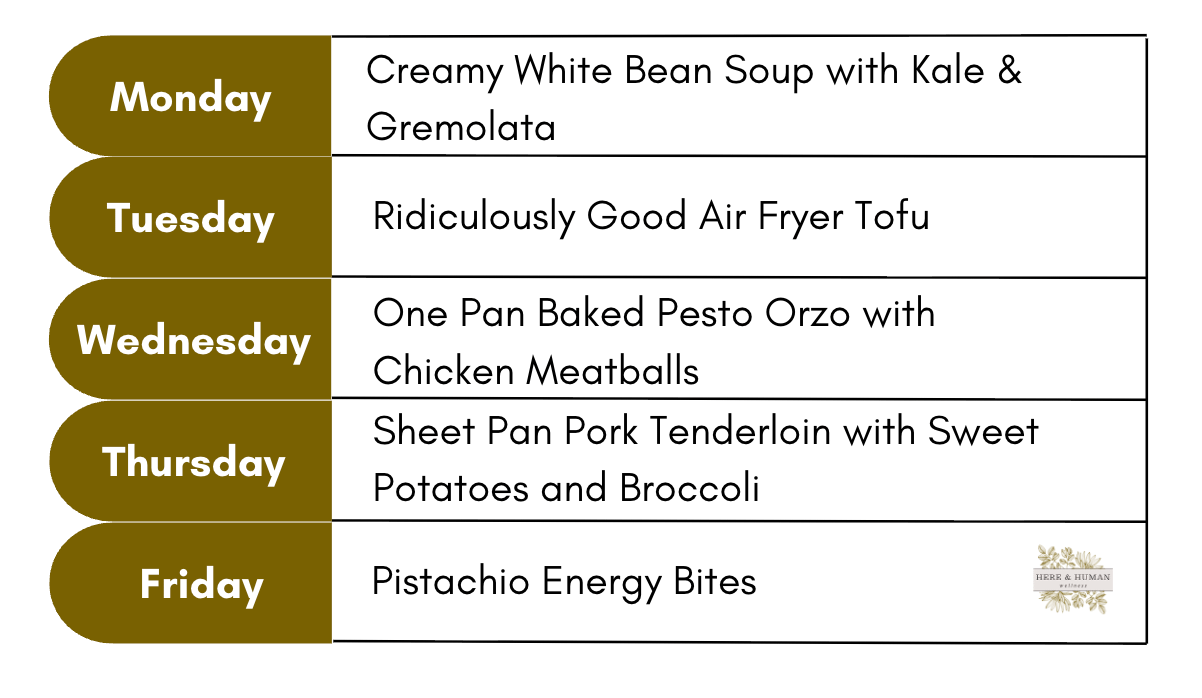
Menu for the Week of January 5-9th
Monday
Creamy White Bean Soup with Kale & Gremolata: Sometimes it’s the small finishing touches that take a simple soup up a notch. I don’t always add them, but this bright, herby gremolata (think pesto-adjacent) is worth it.

Tuesday
Ridiculously Good Air Fryer Tofu: Crispy, flavorful, and endlessly versatile. Perfect for topping grain bowls, salads, or serving alongside roasted veggies and quinoa.

Wednesday
One Pan Baked Pesto Orzo with Chicken Meatballs: A winter warm-up dinner. I’d likely use store-bought meatballs and save some time.

Thursday
Sheet Pan Pork Tenderloin with Sweet Potatoes and Broccoli: A true sheet-pan dinner with minimal prep, easy cleanup. Swap in any veggie or protein you like, and serve with a simple grain to round it out.

Friday
Pistachio Energy Bites: I’ve noticed I’ve been on a pistachio kick. I do love their pretty color and all my protein seekers, did you know they are the highest protein nut?

Walk on, friends! XO- Jen