


Last week I taught two corporate wellness seminars on meal planning.
I’ve taught meal planning in some form for years, and I keep coming back to it, not because I think everyone needs a perfectly organized menu hanging on the refrigerator, but because meal planning saves me an enormous amount of precious energy during the week.
I was talking with a client recently who wants to start exercising after work. But she noticed that on days when she doesn’t know what she’s making for dinner, going to work out feels much harder. There’s already this unfinished task waiting for her: What are we eating? Do I have the ingredients? When am I going to make it?
Skipping the workout and going home feels like the responsible choice.
That’s what I think we sometimes miss when we talk about meal planning. Yes, it can save money. It can reduce food waste. It can make it easier to eat in ways that support how we want to feel.
But for me, one of its biggest benefits is that it frees up capacity.
When I already know what we’re having for dinner, I don’t have to start solving that problem at 4:30 p.m. I’ve made one less decision. There’s a little more space for a walk, a workout, helping a kid, getting something done, or simply not having to think so hard.
And importantly, creating that kind of ease doesn’t require becoming an expert meal planner.
In fact, that was one of my favorite reminders from these seminars.
I came prepared with plenty to teach: ways to make meal planning simpler, how to build a short list of dependable meals, strategies for grocery shopping and prep, and ideas for getting dinner on the table when no one has much energy left.
But one of my favorite parts of teaching in a group is that I’m never the only person in the room with something useful to share.
Put a group of people together and suddenly you have dozens of kitchens, schedules, families, preferences, frustrations, and solutions represented. Someone has figured out the grocery app that actually works. Someone else has a shortcut food everyone in their house eats. Another person asks a question that half the room was probably wondering themselves.
And that happened over and over during these sessions.
One woman introduced us to AnyList, an app she loves for keeping track of meals and groceries. Someone mentioned Wyman’s frozen smoothie fruit packs. We talked about easy protein options, including egg-white bites and RXBAR’s newer protein bites.
None of those ideas came from my Canva presentation.
Then there were the questions…and those may have been even more useful.
What if I’m cooking for one?
Meal planning advice tends to assume you’re feeding a family, but cooking for one comes with its own challenges. Making a different recipe every night can mean buying too many ingredients, creating too many leftovers, and doing an unreasonable amount of cooking for one person.
Instead, it can help to think about ingredients that can become several different meals. Roasted vegetables might go into a grain bowl one night and alongside eggs the next. A rotisserie chicken could become tacos, a salad, and a sandwich. You’re still getting variety without starting from scratch every night.
What if one person loves leftovers and the other absolutely does not?
This is such real-life meal-planning problem…
The solution probably isn’t convincing the leftover-hater that leftovers are wonderful. Instead, we talked about making components that can be repurposed. Tonight’s taco ingredients might become tomorrow’s burrito bowl. Grilled chicken might show up in pasta the next night. The ingredients repeat, but the meal doesn’t feel exactly the same.
What about picky eating?
This opened up a bigger conversation. There is a difference between ordinary food preferences or selective eating and a child whose eating has become restrictive enough that additional support may be warranted.
We talked about resources for understanding when picky eating deserves more attention, but also about taking some pressure off at home. Feeding a family doesn’t require finding a meal that every person enthusiastically loves. Sometimes success is simply putting together a meal where everyone has something they can eat.
One of the strategies I shared was something I often encourage families to create: a list of 5–10 minimum-effort meals.
These aren’t aspirational dinners.
They’re the meals almost everyone will eat, that you know how to make without looking at a recipe, and that you can pull together fairly quickly if you keep a few basic ingredients around.
Maybe yours are tacos, breakfast for dinner, pasta and meatballs, quesadillas with fruit, a rice bowl, frozen dumplings with vegetables, or rotisserie chicken with a bagged salad and bread.
Get your family involved and ask: What are five or ten dinners we would all be reasonably happy to see on the table?
Write them down.
In fact, write down any dinner that works.
One participant mentioned how helpful it is simply to keep an ongoing list of meals you’ve made and liked. We tend to think we’ll remember them. Then Tuesday afternoon arrives and somehow we can’t think of a single thing we have ever cooked.
Your own meal history can become one of your best meal-planning resources.
And perhaps my favorite tip was about not doing everything on Sunday.
Meal planning advice often makes Sunday sound like a part-time job: plan the meals, make the grocery list, shop, wash the produce, chop the vegetables, prep the proteins and prepare food for the week.
If that genuinely works for you, wonderful.
But we don’t get extra credit for doing it all in one day.
I usually spread it out. I might plan meals on Friday, get groceries on Saturday, and do a little prep on Sunday while everyone else is watching NFL football.
The work still gets done. It just doesn’t become one giant weekend project.
Maybe that was my biggest takeaway from these conversations.
There isn’t one system for meal planning that we all need to get better at following.
There are people cooking for five and people cooking for one. People who happily eat the same lunch four days in a row and people who cannot stand leftovers. Kids who eat almost anything and kids who eat twelve foods. People who love to cook and people who would prefer to spend as little time in the kitchen as humanly possible.
Good meal planning has to work inside the life you actually have.
And maybe its purpose isn’t to make us better meal planners at all.
Maybe it’s simply to take one recurring task, the relentless question of what are we going to eat? and make it require a little less of us.
A little less decision-making. A little less scrambling. A little less energy.
So there’s more capacity left for everything else we want to do with our lives.
And one more thing: don’t forget delegation. Just because you’ve always been the one to do it all doesn’t mean it has to stay that way.
Menu for the Week of September 28th - October 2nd
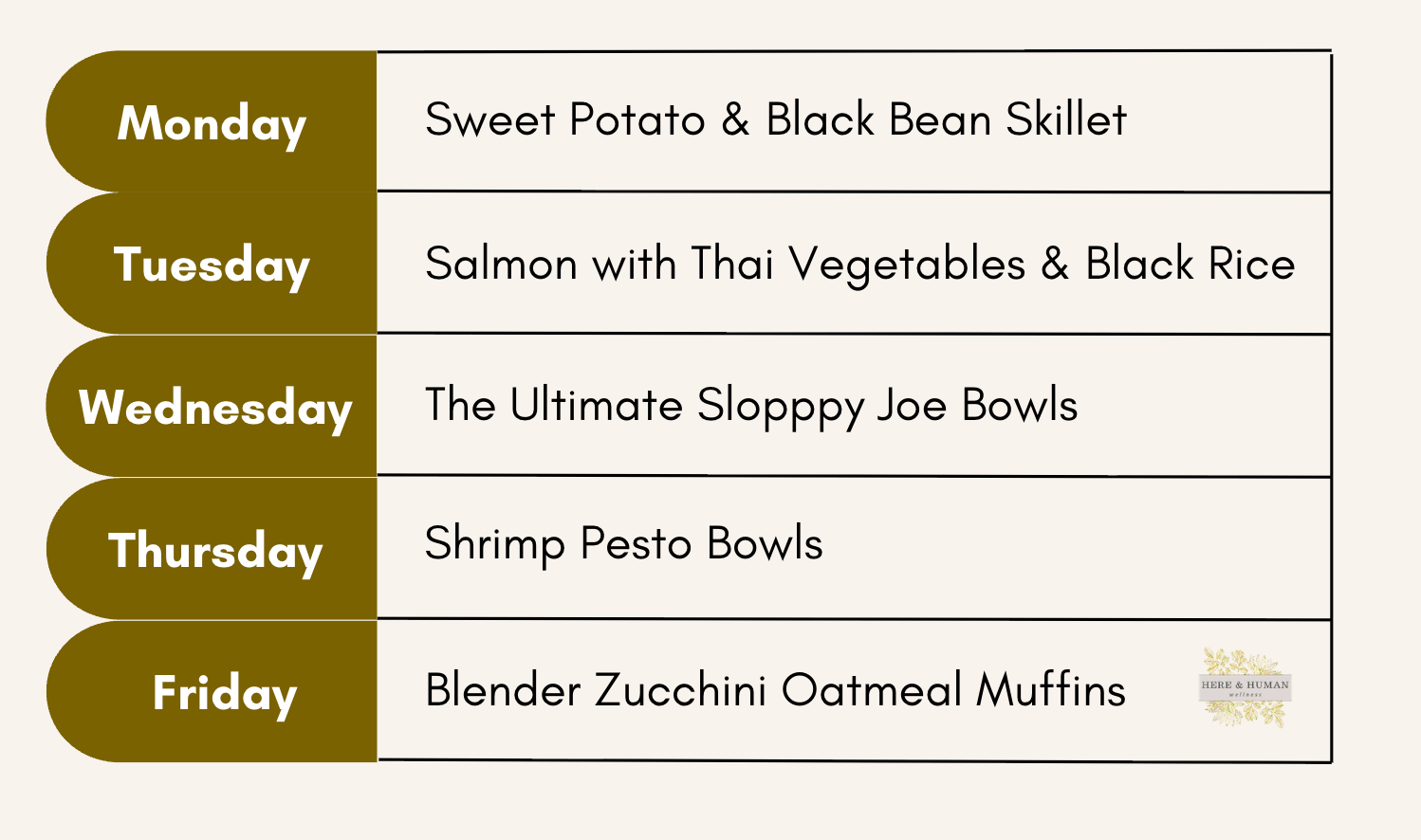
Monday
Sweet Potato & Black Bean Skillet

Tuesday
Salmon with Thai Vegetables and Black Rice

Wednesday

Thursday

Friday
Blender Zucchini Oatmeal Muffins

XO - jen