


I recently read a story about a woman visiting her grown daughter.
She walked into the kitchen and noticed dirty dishes sitting in the sink.
That was the first thing: there were dishes in the sink.
But her mind didn’t stop there.
How long have those been sitting there? Why doesn’t she clean up after herself? Is she overwhelmed? Is she depressed?
And eventually, the thought landed somewhere much closer to home:
Did I raise a daughter who doesn’t know how to take care of herself?
Somewhere between seeing the dishes and asking that question, something happened.
The dishes stopped being dishes. They became evidence.
Evidence about her daughter. Evidence about how she had parented. Evidence, ultimately, about herself.
There were, of course, a million possible explanations for those dishes. Maybe her daughter had been running late. Maybe she’d had friends over. Maybe she was planning to wash them after work. Maybe she simply didn’t care very much about dishes sitting in the sink.
But I’m becoming interested in something even more basic than figuring out which explanation is true.
What happens if we notice the difference between description, meaning, and story?
The description
A description stays fairly close to what actually happened or what we’re experiencing.
There are dishes in the sink.
That’s it.
And I’m going to make a fairly large leap from dirty dishes to something that comes up constantly in my work: our bodies.
Imagine a woman going through perimenopause whose body has changed. She steps onto a scale and sees that her weight has moved from 147 pounds to 156.
The description might simply be:
My weight has changed from 147 to 156.
Nine pounds.
End of statement.
That doesn’t mean she can’t have feelings about the change. It doesn’t mean she can’t decide she’d like to do something differently. Maybe her clothes aren’t as comfortable. Maybe she’s physically uncomfortable. Maybe her doctor has brought up something worth paying attention to. Maybe she decides to buy a pair of pants that fits her current body better.
Description doesn’t mean passivity.
It simply doesn’t require us to immediately turn what happened into something about who we are.
Then comes meaning
This is where things can change very quickly.
What does 156 mean about me?
Maybe:
I’ve let myself go.
I haven’t been disciplined enough.
I have no willpower around sweets.
I should have been paying more attention.
Now we’ve moved beyond the number.
The number has become evidence about the person standing on the scale.
And from there, the mind has plenty of material for a story.
Then comes the story
If I don’t get on top of this now, my weight is going to keep creeping up.
I’m going to end up gaining another ten pounds.
I need to get myself under control.
Notice how far we’ve traveled from:
147 became 156.
The story may reach backward, gathering evidence from the past. It may reach forward, predicting what will happen next. It may compare us to someone else. And very often, it creates a character at the center of all of it:
me.
The undisciplined me.
The inconsistent me.
The me who can’t get it together.
And perhaps this is worth noticing because somewhere along that path, suffering often gets added to an experience that may already be uncomfortable.
The same thing can happen around food, where a physically uncomfortable experience can quickly become a judgment about who we are.
A meal becomes a judgment about who you are.
You go out to dinner and eat more than feels comfortable.
Description:
My stomach feels really full.
I ate past the point that felt good.
Taking a walk sounds good right now.
Meaning:
I have no self-control around food.
Story:
I always do this at restaurants. If I keep eating like this, I’m going to get completely out of control.
Again, none of this means we can’t learn from an experience.
Maybe you realize you don’t enjoy feeling that full. Maybe next time you want to eat differently. Maybe there genuinely is something about your eating that deserves attention.
But those possibilities don’t require turning one uncomfortable dinner into a statement about your character.
We do something similar when circumstances disrupt the routines we associate with taking good care of ourselves.
A busy week becomes evidence that you don’t prioritize yourself. Work has been unusually demanding and you miss several workouts.
Description:
Work was heavier than usual this week.
I didn’t make it to the gym.
My body misses moving.
Next week I’m going to ask my husband to pick up the kids one afternoon so I can go.
Meaning:
I always put work before myself.
Story:
I’m so easy to derail. My husband somehow manages to exercise no matter how busy he is. If I can’t even stay consistent with this, I’m never going to make progress.
There it is again. It became something about me.
Then that meaning became part of a much larger story about who I have been, who I am, and what is likely to happen to me next.
Where does the suffering begin?
I’m not suggesting that we police our thoughts or try to replace every “negative” story with a more positive one.
I gained nine pounds, but that’s okay!
That’s still meaning-making. It’s just meaning-making that sounds nicer.
I’m more interested in seeing what was there before we decided what it meant.
There are dishes in the sink.
The scale says 156.
My stomach is very full.
I haven’t exercised this week.
Perhaps there’s information there. Perhaps there’s an action to take. Perhaps there isn’t.
But before moving on, it might be interesting to notice when the mind adds the next layer:
And this means something about me.
A few things I’ve been playing with:
Find the description. What happened before you explained it? What could a camera have captured, or what can you directly feel in your body?
Listen for identity language. I’m lazy. I’m undisciplined. I’m bad at this. I always do this. That’s often a clue that description has become meaning.
Notice time travel. I always… I never… This is going to… If I keep this up… may signal that a present experience has expanded into a story about the past or future.
Check the body. What happens physically when you say, I haven’t exercised in a week compared with I’m so inconsistent? Sometimes the body recognizes the difference before the mind does.
Remember that description doesn’t prevent action. Seeing something without making it mean something about you doesn’t mean ignoring it. You can buy the bigger pants. Make the doctor’s appointment. Take the walk. Ask for help. Go to the gym next week. Wash the dishes.
Maybe the invitation isn’t to stop telling stories.
Maybe it’s simply to become a little more aware of when we have left what happened and begun telling ourselves what what happened means about who we are.
And to notice how different those two things can feel.
Menu for the Week of September 21-25th
Recipes inspired by this past week’s silent retreat.
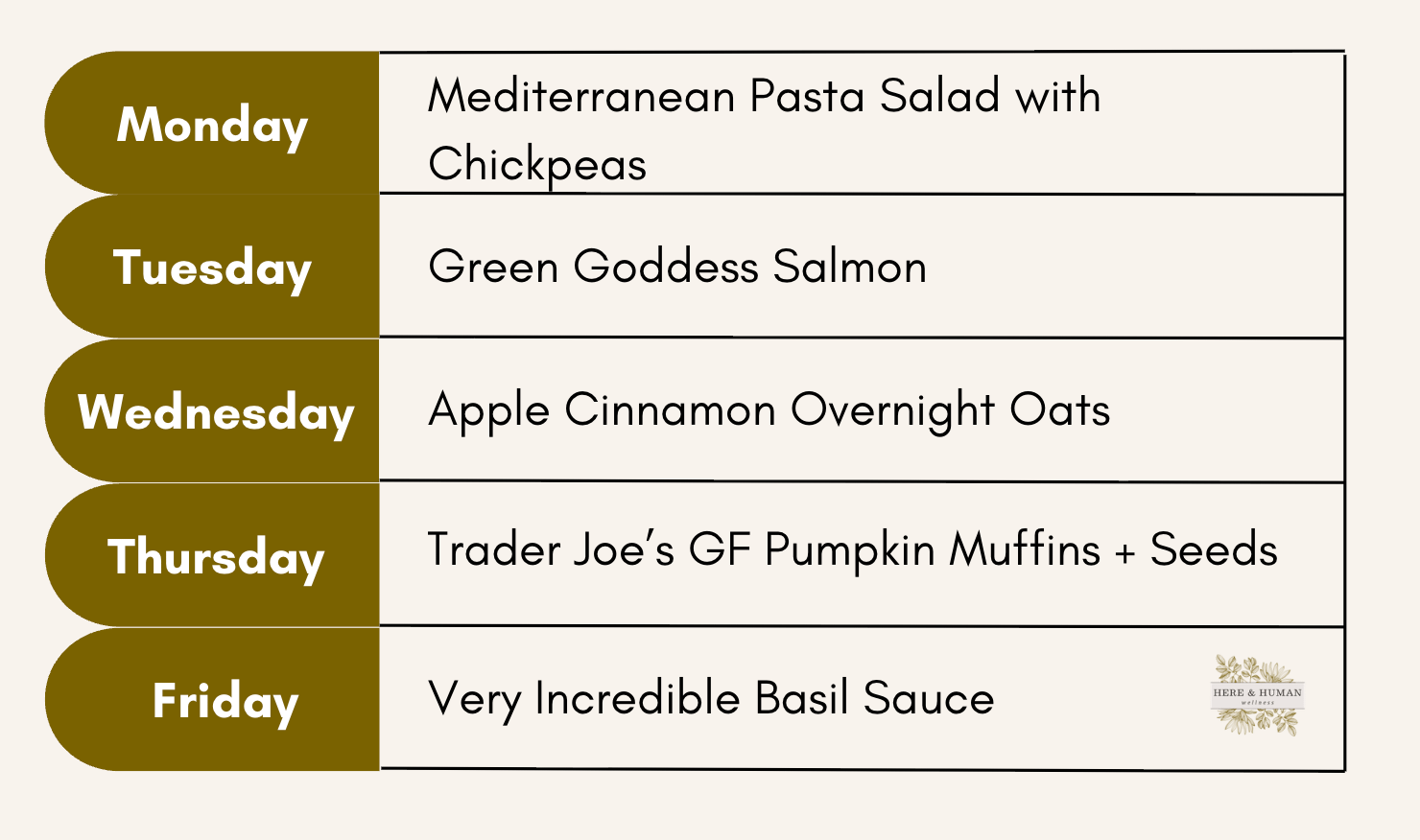
Monday
Mediterranean Pasta Salad with Chickpeas

Tuesday

Wednesday

Thursday
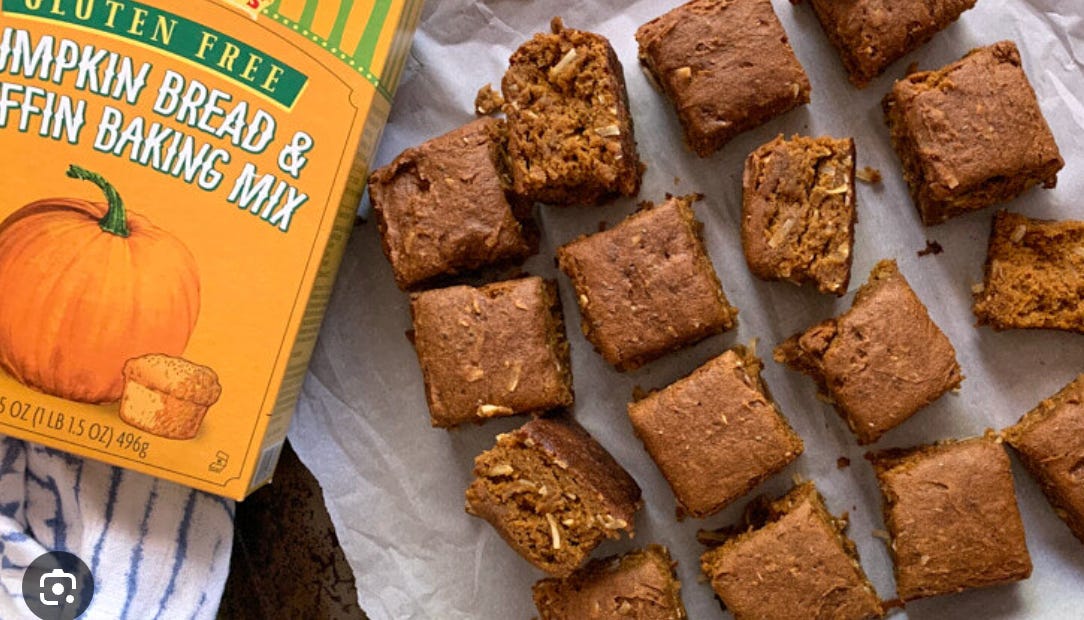
Trader Joes’ Gluten-Free Pumpkin Muffins with Seeds (no link here, but this mix is awesome, and I added pumpkin seeds, chia seeds, walnuts and sunflower seeds & topped with peanut butter. YUM.
Friday

May fall show up, soon. XO
We need some soup recipes…
Meaning-making so clearly and beautifully broken down and so, so helpful. ✨