


Let me start with this: I’m not immune to what I’m about to talk about.
I get asked about supplements all the time, and honestly, I’m cool with it. It keeps me tuned in to what’s trending on social media, what people are curious (and sometimes confused) about, and most importantly, what the current body of evidence actually says.
Over time, I’ve noticed most people fall into three broad categories:
1. The Skeptics
These are the people who don’t really want to take anything at all—even something as basic as vitamin D.
“Can’t I just get it from the sun? Or food?”
They’re wary of pills and prefer to keep things as natural and minimal as possible.
2. The Optimizers
On the other end, we have people taking a wide assortment of “foundational” supplements, like omega-3s, plus a long list of others targeting longevity, gut health, or inflammation.
They’re informed, intentional, and often deeply invested in their health routines.
3. The Curious Middle (Hi, it’s me)
This is where I land.
We take the basics, but we’re easily intrigued by something we read, hear on a podcast, or get recommended by a friend. We try it for a month, don’t notice much, and then quietly forget about it.
If you looked inside my supplement graveyard, you’d find things like resveratrol, NAD, and colostrum, all things I’ve tried… and no longer take.
The Inspiration Behind Today’s Post
This past month, one of my clients, an incredible endurance athlete, started our session by saying she had been “flirting around with some supplements.”
But when I asked why, she paused and admitted: she didn’t actually know.
Before diving into the research (and no, high doses of antioxidants aren’t doing athletes any favors), I asked a different question:
Why do these supplements feel appealing right now?
What do you think isn’t working that you’re hoping they’ll fix?
After a moment, she shared:
She had lost a little weight
Her energy had been low
She had a recent race that didn’t go well
And just like that, the conversation had shifted from supplements to something much more foundational.
We talked about:
How to get more fuel into her very full days
How to better support her sleep
Whether it made sense to recheck her iron levels
Ah, the “boring basics.”
The things that take time.
The things that require consistency.
The things that no supplement can fix overnight, but almost always matter the most.
Strive, Strive, Supplement
Most of us are living in a near-constant state of doing.
It’s the pace of modern life—and in many ways, the way we’ve been conditioned to operate.
For some, this pace is especially intense.
Think about phases of life where the demands stack up—like the “sandwich generation,” caring for both kids and aging parents.
It’s just one example of how full life can get.
We move from one thing to the next.
Putting out fires.
Checking boxes.
Keeping everything afloat.
And even if we say, “I’m not stressed,” if you zoom out and look at what one human is doing in a single day… it’s hard to argue that the body isn’t spending more time in fight-or-flight than rest-and-digest.
This post isn’t about overhauling your entire life or doing less (though that might not be a bad goal).
It’s about recognizing something more fundamental:
Supplements cannot be the solution to a lifestyle running on overdrive.
We cannot supplement our way out of a fight-or-flight lifestyle.
Where Supplements Do Have a Place
With all that said, I’m not anti-supplement.
There are absolutely situations where they can be helpful—and even impactful.
In my practice, I tend to come back to a handful that can benefit a larger portion of the population:
Vitamin D3
Especially with limited sun exposure (which, for most of us, is the reality). This is one of the most common gaps I see.Omega-3s
If fatty fish isn’t showing up at least twice a week, supplementation can help support heart, brain, and overall inflammation balance.Creatine
Traditionally associated with athletes, but we’re now seeing benefits beyond performance, including support for muscle mass, strength, and even cognitive health as we age. This is one I’m watching closely and using more often in the right individuals.Targeted supplementation based on labs
This is where things get personal. Nutrients like iron, B12, or others should be guided by data, not guesswork. (Iron, in particular, is something I’ll be writing more about soon, as it’s a personal focus for me right now.)
Beyond these, there are also situational supplements that can be incredibly helpful in the right context:
Fiber supplements (like psyllium husk)
Many people aren’t meeting their fiber needs through food alone. In those cases, this can support digestion, cholesterol, and blood sugar, but it works best alongside hydration and a fiber-rich diet.Magnesium
Helpful for sleep, muscle function, and stress regulation, areas where many people are coming up short. The form and dose matter here, and more isn’t always better.Prebiotics
These help feed the beneficial bacteria already living in your gut. For some, adding prebiotics (through food or supplements) needs to be individualized, as introducing them too quickly, or in the wrong context, can sometimes create more digestive discomfort than benefit.
Helpful? Yes.
Necessary for everyone? No. Because even here, the goal isn’t to override the system, it’s to support it. Supplements can help fill gaps, but they can’t replace the foundation.
Which always brings us back to the same place:
food, sleep, stress, and consistency.
My Own Detours Down the Supplement Aisle
I’ve absolutely found myself purchasing things like NAD, colostrum, resveratrol… all of it. And who knows—maybe they were doing something beneficial.
But what I can say is:
They were expensive
I didn’t notice meaningful changes in my day-to-day life
And I was likely influenced by a podcast or seminar that made them sound like the answer to everything
The supplement industry is incredibly convincing.
The scripting is good.
The sound bites are good.
The testimonials are really good.
And honestly—what’s not appealing about the idea that you could fix something by simply taking a pill…
…instead of reorganizing your schedule, cooking more, or getting more sleep?
Why Quality Actually Matters (More Than We Think)
This is the part of the conversation that doesn’t get enough attention.
Not all supplements are created equal. And in the U.S., they’re not regulated in the same way as medications, which means what’s on the label isn’t always what’s in the bottle.
In fact, some data suggests that a significant percentage of supplements may contain ingredients not listed on the label.
That matters.
It matters for safety
It matters for effectiveness
And for some people, like college or higher level athletes, it really matters when it comes to banned substances
This is where third-party testing becomes important.
When a supplement is third-party tested, it means an independent organization has verified:
The ingredients listed are actually in the product
They’re present in the stated amounts
And the product is free from harmful contaminants
You might see certifications like:
NSF Certified for Sport (especially important for athletes)
USP (United States Pharmacopeia)
GMP (Good Manufacturing Practices)
GMP, in particular, speaks to how a product is made—ensuring consistency, cleanliness, and quality control during production.
Because without these layers of accountability, you’re often relying on the company’s word alone.
And in an industry driven heavily by marketing, that’s not always enough.
A Quick Reality Check on “Super” Supplements
I’ve jumped on the bandwagon before.
At one point, I overdid a fiber supplement and disrupted my digestion for a solid week. I now have multiple containers sitting in my pantry… that I’m not quite sure what to do with.
We’ve all seen the trends:
Probiotics for everything
Greens powders with 60+ ingredients
Fiber blends promising total gut repair
But as we learn more about things like the microbiome, one thing is becoming clear:
More is not always better. And random is rarely effective.
Taking a probiotic without understanding the strain, or the need, can be unhelpful, or even counterproductive.
And those greens powders? The variety looks impressive, but the actual dose of each ingredient is often so small that it doesn’t compare to real food.
A few bites of vegetables will almost always deliver more meaningful nutrition than a scoop of powder.
The Supplement Health Halo
There’s also something more psychological happening. Taking supplements can create a sense that we’re “doing something” for our health.
And sometimes, that can take the pressure off the things that matter more:
Planning meals
Sitting down and eating
Eating enough
Supporting sleep
Creating moments of calm
The basics aren’t flashy. They don’t come in aesthetic packaging or subscription models. But they are incredibly effective.
Before We Invest, Investigate!
Instead of chasing what’s new, I’ve found it more helpful to pause and ask:
Why am I wanting to take this?
What problem do I think this will solve?
Is there something more foundational I should address first?
Could eating more, sleeping better, or reducing stress do more here?
Who is recommending this, and do they benefit from it?
Is this product third-party tested?
Can I actually measure whether it’s working?
Because if something sounds too good to be true… it usually is.
The Bottom Line
Supplements can absolutely have a role. But they are not the savior.
If a supplement might move the needle 5%, but getting 30 more minutes of sleep could move it 80%, that’s where our attention might go first.
So before adding something new, we can pause. We can ask questions and consider redirecting some of that energy, and money, toward the things that truly support your health.
Like checking out the local farmer’s market.
Eating and only eating versus meal multi-tasking.
Going to bed 15 minutes earlier.
Investing in more Vitamin P: pleasure!
Menu for the Week of April 6-10th
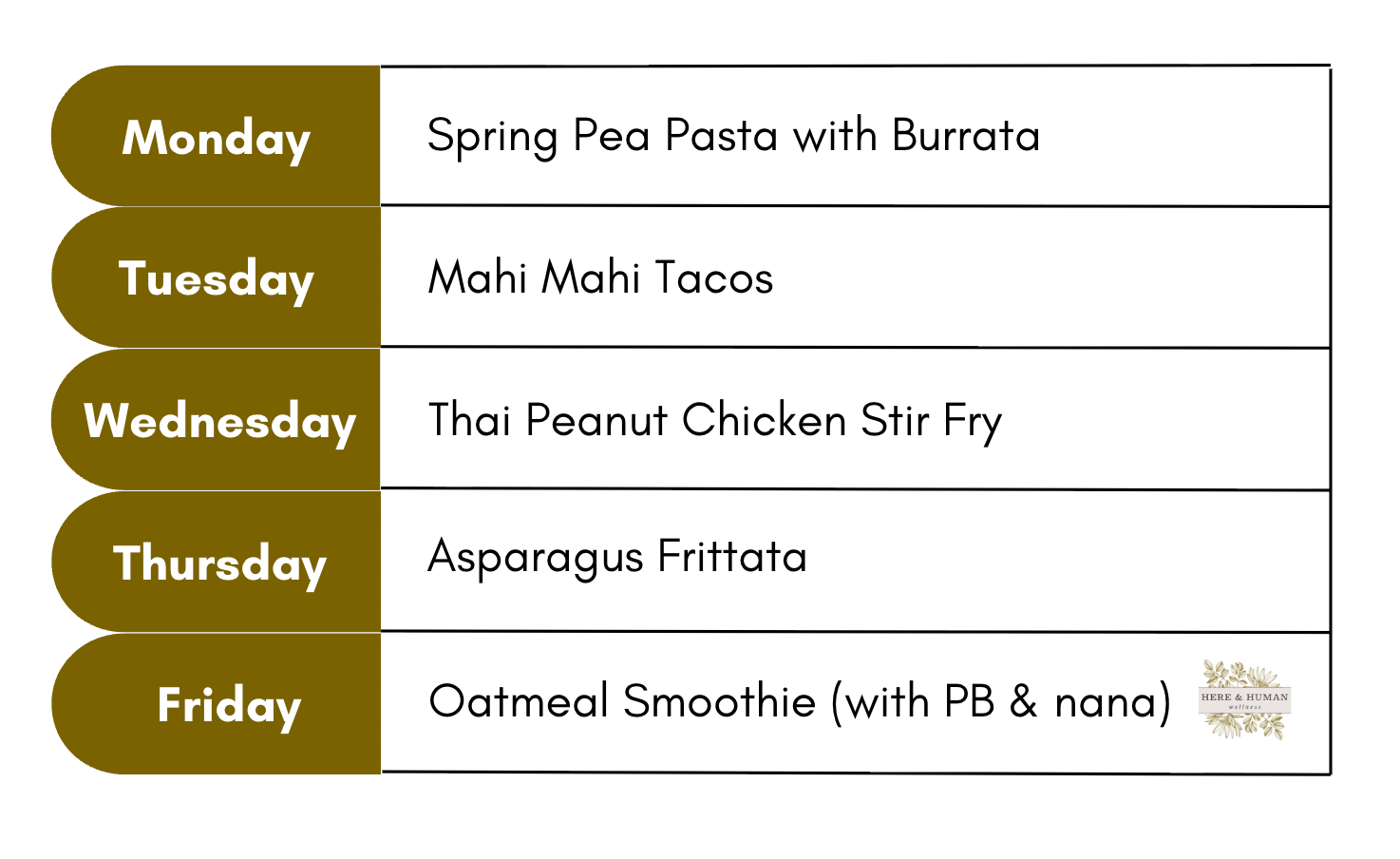
Monday
Spring Pea Pasta with Burrata: I love a vibrant green spring pasta with fresh mint, basil, and the humble, protein-rich pea. Creamy burrata adds just the right touch of indulgence!

Tuesday
Mahi Mahi Tacos: Mahi mahi is one of my favorite white fish options thanks to its firm texture and mild, crowd-pleasing flavor. With the spring warm-up (and a few summer-like days here in St. Louis), it’s the perfect time to fire up the grill.

Wednesday
Thai Peanut Chicken Stir-Fry: A flavorful, well-balanced bowl with savory peanut sauce and plenty of texture, easily served deconstructed for eaters who prefer their foods separate.

Thursday
Asparagus Frittata: Spring vegetables meet this easy, protein-packed egg dish—perfect for a simple, satisfying breakfast or lunch.

Friday
Oatmeal Smoothie (with PB & Banana): Think of this as your favorite bowl of oatmeal, blended with peanut butter and banana into a creamy, drinkable breakfast that keeps you going.

XO - Jen
This is all so helpful, Jen. I need the reminder to return to the basics, instead of searching for silver bullet solutions—AND to be open to small tweaks (like going to bed 15 minutes earlier!) instead of big, flashy overhauls.