


I have some version of the same conversation with probably 80 percent of my clients.
At some point, while we’re talking about physical activity or exercise, an injury, pain, or physical limitation comes up.
Sometimes it’s an old injury that flares when they train. Sometimes it’s something recent. And sometimes it’s simply the collection of aches, pains, and changes that can come with getting older.
A few years ago, I was dealing with significant foot pain of my own.
I had intense, nerve-like pain around my heel. It hurt whether I was walking, sitting, exercising, or doing absolutely nothing. I saw countless practitioners trying to understand what was wrong. Perhaps even more significantly, my mind became completely consumed with figuring out how to fix it.
This went on for about nine months.
Eventually, an MRI revealed a 50 percent tear in my plantar fascia. That could certainly have accounted for some of the pain, but it didn’t seem to explain all of it.
To support the healing of the tear, I decided to have a PRP injection. I rested. I also read several books about the relationship between the mind and pain and began exploring the practice I’m going to tell you about next.
Today, I’m able to run again.
So what made the pain go away? Was it the rest? The PRP injection? What I learned about pain and the brain? The practice I began using with my body?
Honestly, I don’t know.
But one approach became, and remains, an important part of how I relate to pain, movement, and my body: the Feldenkrais Method.
The strange little practice that changed how I move
I found Feldenkrais through a friend.
Somewhere around month nine of my foot saga, I posted a picture on Instagram saying I was training for a century bike ride because I had no idea when, or whether, I would be able to run comfortably again.
My friend Sandy Weiss reached out. Sandy is a physical therapist and Guild Certified Feldenkrais Practitioner here in St. Louis, and she introduced me to an entirely different way of thinking about movement.
When I mention Feldenkrais to clients now, very few have heard of it.
Which is one of the reasons I wanted to write this.
Of all the things I’ve done to support my body - running, strength training, yoga, physical therapy, mindfulness, and meditation - Feldenkrais has been one of the most influential.
And it is remarkably difficult to explain.
So what exactly is Feldenkrais?
The Feldenkrais Method was developed by Moshe Feldenkrais, a physicist, engineer and martial artist born in 1904. He studied physics at the Sorbonne in Paris and became one of the first Europeans to earn a black belt in judo. After dealing with a significant knee injury of his own, he began exploring the relationships among movement, physics, biomechanics, learning, and the nervous system. That exploration eventually became the Feldenkrais Method. (Feldenkrais Method)
Today, it is generally described as a form of somatic education: using gentle movement and attention to bodily sensations to become aware of habitual patterns and explore other possibilities for moving. (Feldenkrais Method)
There are two primary ways it is taught.
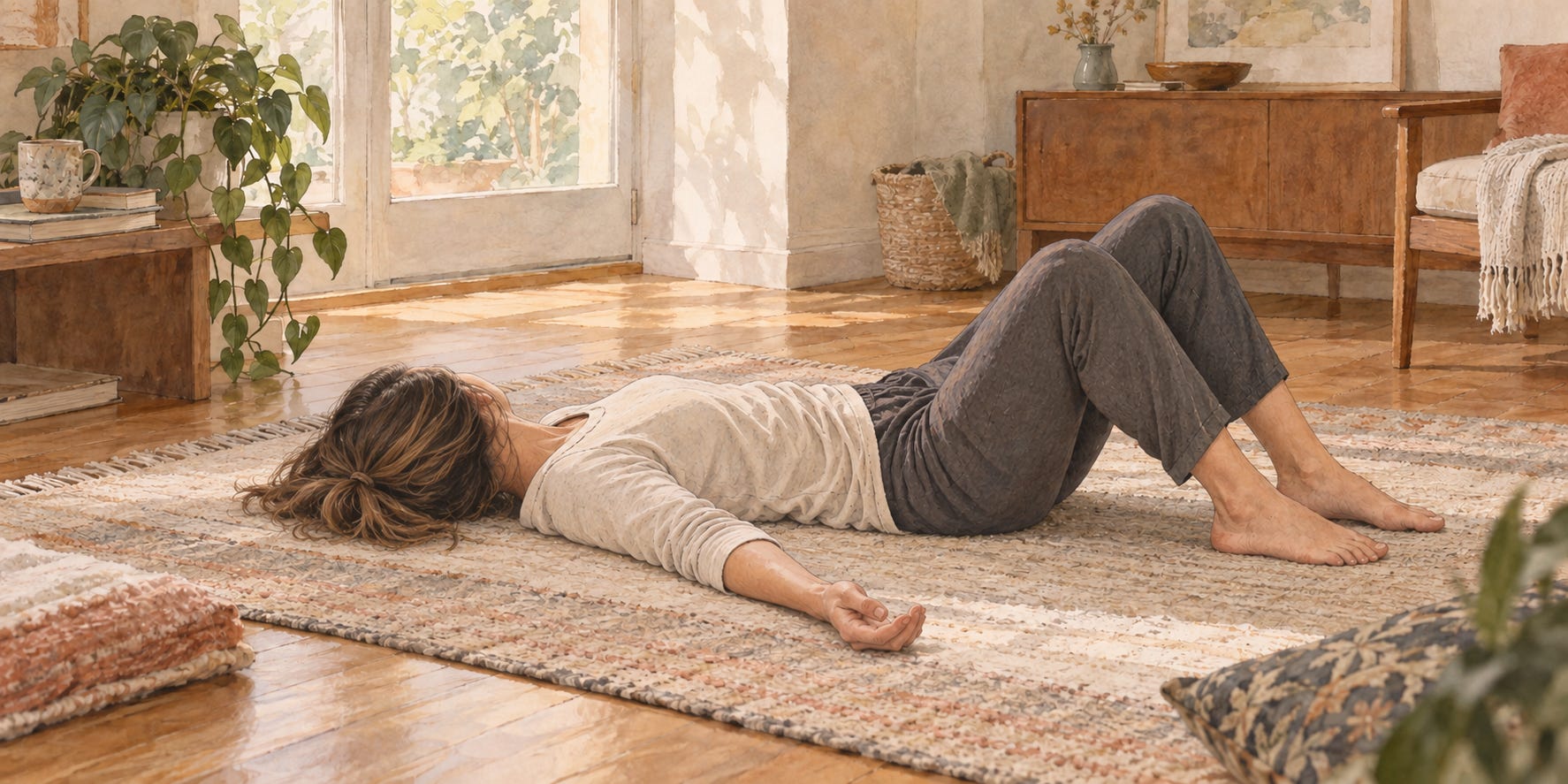
Awareness Through Movement lessons are generally guided verbally. You might lie on the floor while a teacher invites you to make a series of very small movements and notice what you feel.
Functional Integration is one-on-one. A practitioner uses gentle touch and movement to help you experience different possibilities for how your body can organize itself.
Honestly, I find it easier to explain Feldenkrais by saying what it isn’t.
It isn’t exercise.
It isn’t stretching.
It isn’t trying harder.
It isn’t forcing your body into the “correct” position.
And it isn’t about doing more.
In fact, much of the time it feels like the opposite.
What a lesson actually feels like
Many Awareness Through Movement lessons happen lying on the floor.
You might begin simply by noticing how your body contacts the ground. Does one shoulder feel heavier? Does one side of your pelvis feel different from the other? Where do your heels rest? How does your head want to turn?
Then you begin moving.
Slowly.
Maybe you roll one knee a few inches. Turn your head. Move your eyes. Shift your pelvis. Lift a shoulder.
Nothing particularly impressive happens from the outside.
The movements are often deliberately small and comfortable. You’re encouraged to notice differences rather than push through them, and to reduce unnecessary effort rather than stretch farther or work harder.
And this is probably the part I love most:
You don’t have to fix yourself.
I have spent plenty of time doing physical therapy exercises while thinking very hard about whether my knee was tracking correctly or my glute was firing or my core was engaged.
Feldenkrais feels different.
I pay attention while I’m doing the lesson. I explore. I notice. And then I get up and go about my life.
I don’t spend the rest of the day reminding myself how I’m supposed to walk.
The learning happens through the experience itself.
There is something about that idea that extends well beyond movement for me.
Maybe we don’t always learn best by trying harder.
Maybe sometimes we learn by becoming sensitive enough to notice another possibility.
Your body isn’t the problem
There is another piece of Feldenkrais that I didn’t expect to matter as much as it does.
It changed the way I think about my body.
So often when we seek help for pain, we leave with a list of everything that is supposedly wrong.
This muscle is too tight.
That one is weak.
This hip doesn’t move enough.
Your pelvis is rotated.
Your leg is doing this thing it shouldn’t be doing.
You can walk out feeling as though you’ve been handed an inventory of your body’s defects.
That wasn’t how Sandy talked about me.
I remember her noticing something one of my legs was doing and explaining that it might be organizing itself that way because it was helping another part of me.
That landed very differently.
Instead of:
Look what your body is doing wrong.
It became:
Look what your body figured out how to do.
Maybe the pattern isn’t useful anymore. Maybe there is another way that would be easier. But the starting place isn’t that the body has failed.
It’s curiosity.
I’ve come to love the idea that my body has been adapting on my behalf for my entire life.
I don’t really think in terms of my “bad foot” and my “good foot” anymore.
They’re both feet. And they’re doing the best they can with the options available to them.
Less effort can create more possibility
Most of us have been taught a very different relationship with our bodies.
Stretch farther.
Strengthen the weak thing.
Push a little harder.
Correct your posture.
Do your exercises.
Feldenkrais asks something closer to:
What happens if you do less?
Could the movement be smaller?
Could it be easier?
Could you stop before you reach the edge?
Could you notice what the rest of your body is doing while one part moves?
There is something almost subversive about discovering that the nervous system can learn through gentleness.
And I can’t help noticing how often this seems true elsewhere in life.
We assume change requires force.
Sometimes it requires attention.
What happens afterward?
This is the part that made me a believer. At the beginning of a lesson, I might notice that one side of my body feels heavier against the floor, or that turning one direction feels easier.
Forty-five minutes later, I stand up.
Same body. My body hasn’t been miraculously repaired.
But something is different.
Walking often feels smoother. I feel more upright without trying to stand upright. My feet seem to meet the ground differently. Sometimes I feel almost lighter, as though gravity has lost some of its strength.
The Feldenkrais Method is built around the idea that awareness gives us access to movement possibilities beyond our habitual ones. In other words, rather than repeatedly telling the body what it should do, we give the nervous system opportunities to experience alternatives.
That has been my experience of it.
Not magic. Learning.
And you don’t have to be injured
This is another misconception I want to clear up.
You don’t need a torn plantar fascia. You don’t even need pain.
Feldenkrais can be used by people wanting to move more comfortably, improve coordination or balance, return to activities they enjoy, or simply become more aware of how they move. Lessons can be done privately, in groups, over Zoom, through recorded audio, and sometimes in just a few minutes.
I’ve also worked with Jae Gruenke, founder of The Balanced Runner. Jae is a certified Feldenkrais practitioner and running-technique expert who has spent more than 20 years adapting the Feldenkrais Method specifically for runners from beginners to Olympians, and especially those dealing with pain or injuries that haven’t resolved through more traditional approaches.
Our work was done remotely through her online camp where I sent her videos of myself running. She studied the way my whole body moved, not simply the place where I was experiencing pain. Based on what she saw, she selected specific Feldenkrais lessons for me to explore.
Now, when something begins cropping up in my body, my knee feels funny, my hip starts talking to me, or running suddenly doesn’t feel quite right, I often stop and return to one of Jae’s lessons..
One option worth exploring
Pain and injury deserve appropriate medical evaluation, and there are absolutely situations where rest, rehabilitation, medication, surgery, or other treatment is necessary.
But I also think our bodies often have more capacity than we give them credit for.
And sometimes when we’re told, You shouldn’t run anymore or At your age, that’s just how it is, we’re hearing the limits of one person’s framework - not necessarily the limits of our bodies.
Curious?
There isn’t one right way to start, but if it’s accessible to you, I love the idea of beginning with a trained practitioner.
Having someone guide you through it can help you understand what the heck you’re supposed to be doing, which, ironically, is mostly learning that you’re not supposed to be trying very hard at all.
After that, there are wonderful ways to explore it on your own.
In St. Louis: My practitioner is Sandy Weiss, PT, GCFP, founder of Mind Body Science Works. Sandy is both a physical therapist and Guild Certified Feldenkrais Practitioner and offers individual Functional Integration sessions as well as Awareness Through Movement classes. (Mind Body Science Works)
For runners: Jae Gruenke, founder of The Balanced Runner, is a certified Feldenkrais practitioner and running technique specialist who has spent more than two decades applying this work specifically to running. I’ve worked with her remotely through video analysis and Feldenkrais lessons.
For free lessons at home: The Feldenkrais Project, created by Nick Strauss-Klein, is an extraordinary resource. It currently offers more than 50 free audio lessons, including a “Getting Oriented” collection specifically designed for beginners. (Feldenkrais Project)
You can also search the Feldenkrais Guild of North America to find a trained practitioner in your area.
Find a Feldenkrais practitioner
I see Sandy every six to eight weeks or whenever my body feels like it could use a tune-up. Between visits, I use lessons at home.
And I still have trouble explaining exactly what happens.
Maybe that’s okay.
You lie down. You pay attention. You move a little. You try less. You notice more.
And somehow, when you stand back up, there are possibilities that weren’t quite as available before.
For my body, yes.
But increasingly, I wonder if that’s true for a lot of things.
Menu for the Week of September 14-18th
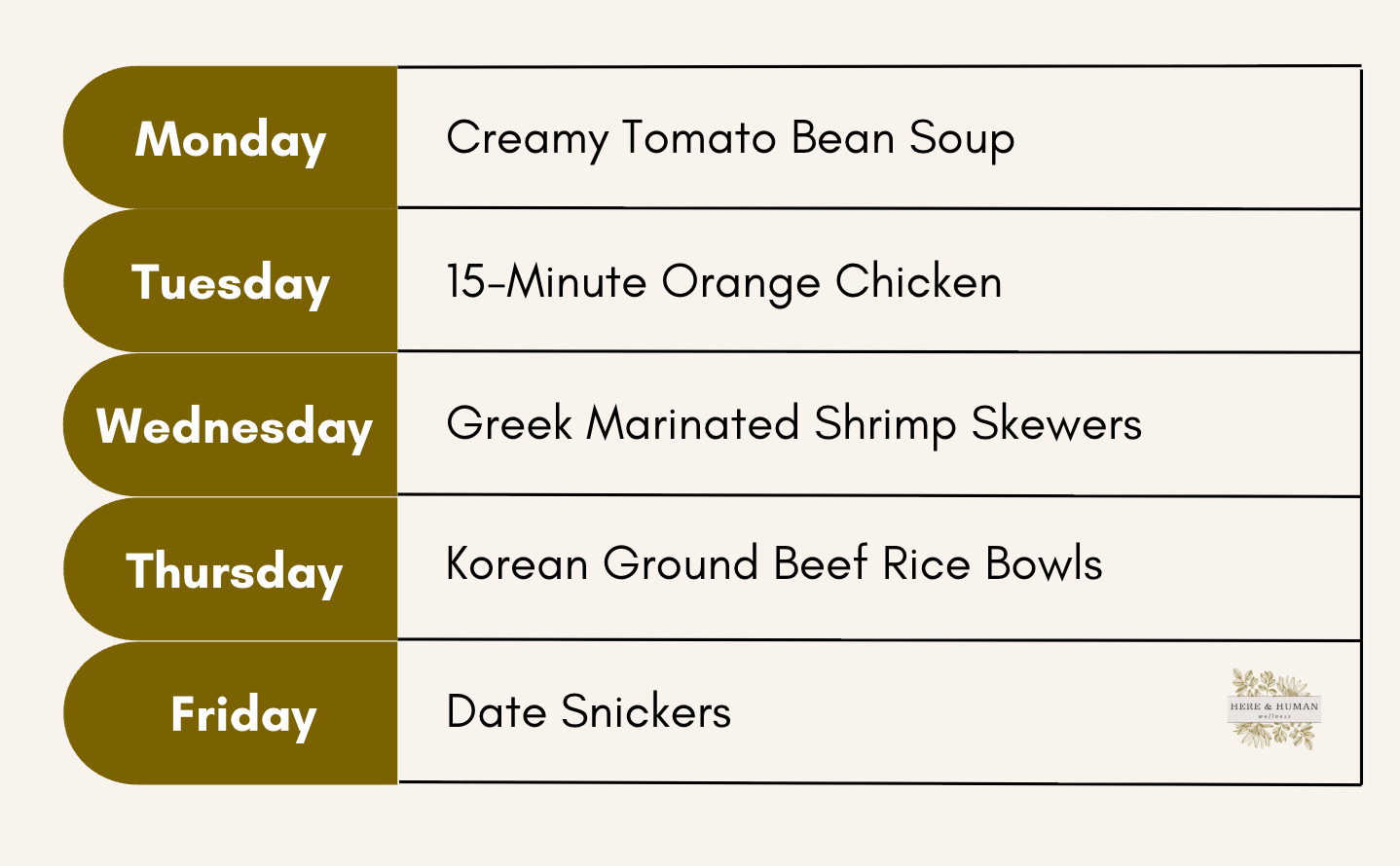
Monday

Tuesday

Wednesday
Greek Marinated Shrimp Skewers

Thursday

Friday

Happy moving, xo Jen