


Women experience body changes throughout life, but in midlife, the tug-of-war between feeling at home in our bodies and feeling pressured to change them often becomes especially strong.
Bodies add weight. Weight settles in new places. Clothes fit differently. This is a natural process of aging, and it’s also the way our bodies protect us. Frailty isn’t associated with longevity.
How these changes are felt, accepted, resisted, ignored, worried about, or embraced is deeply individual. And how we feel about fat and body size is shaped by our conditioning: how we were raised, what doctors told us, what friends commented on, who we spend time with, and what we’ve been taught about health and weight.
We’re also shaped by a culture that reinforces a narrow standard: thin is ideal, and anything else is a problem.
For many women I meet with, these midlife changes spark questions, self-doubt, and sometimes, if we’re honest, a glimpse of our own mortality leading to a game of mental ping-pong:
My body changes need to be addressed ⇄ Screw it, this is the new normal
.
We talk about these frustrations with friends. Social media feeds us “solutions” especially in moments of vulnerability. And when we bring weight concerns to our doctors, the response now often points to what’s seen as the newest and best solution:
“We can put you on a GLP-1. It’s what many women your age are using.”
But that option, for many, isn’t simple either.
Will I have to be on it forever?
Will I lose weight too fast?
What happens to my relationship to food and body? I’ve worked so hard to improve this over the past few years.
What Women Deserve to Know
This week’s free subscriber recipe:
Cranberry Vinaigrette Dressing: Got leftover canned cranberry? This vinaigrette is one of my go-to sweet-tart dressings. With cranberry, Dijon mustard, and olive oil, it’s a bright, flavorful topper for almost any salad.

Women deserve to hear that:
A body adding weight with age is normal.
Larger bodies require more food, not less.
Many women in midlife are under eating, without realizing it.
Staying in a culturally “small body” at midlife is the exception, not the norm, and often comes with a ton of unsustainable “work.”
A client of mine, who had gained 15 pounds through her menopause transition, shared that her doctor told her this a few weeks ago:
“You’re eating well, you’re moving daily, and your labs are within normal ranges. I don’t see a problem with your weight.”
That kind of message is rare, a diamond-in-the-rough moment of validation that a larger body doesn’t need fixing.
Are You Eating ENOUGH?
One of my dietetic interns, who shadows sessions with me, recently commented:
“It’s wild how many women come in thinking they’re overeating, but once we review what they eat, they’re actually not eating enough.”
She’s right. It’s super common for my female clients to expect that I will tell them to eat less.
More often than not, our conversation goes in the opposite direction.
When I show a woman how much food she needs to support her muscle, bone, workouts, hormones, mood, and energy, she often looks at me, like I can’ be right!
“Oh my gosh… that’s so much food.”
And I get it. After decades of diet-culture messaging, it’s easy to think we should always be eating less. Then we wonder why we’re exhausted, anxious, moody, unable to sleep, or plagued by constant food noise.
Often that food noise isn’t just physical hunger but mental hunger—unmet needs for rest, pleasure, connection, or comfort. When those needs go unfed, our minds fixate on food because we’re wired for survival. Restriction also makes body changes harder to cope with and fuels the deprive-and-devour cycle: we restrict, our bodies protest, we lose control, and the shame spiral begins again.
On the flip side, fueling adequately and honoring hunger and fullness, quiets food noise and settles moods.
The Illusion of the “Right” Body
A larger body requires more food.
And this is where the tension lies for so many women:
“Do I feed myself well and risk staying at a higher, natural weight?
Or do I restrict and do everything I can to stay culturally acceptable?”
And what about health?
It’s very possible for health metrics to stay stable or even improve at a higher weight when positive nutrition and lifestyle shifts are made - even without weight loss. And if metrics are affected, they can often be addressed without assuming weight loss is the only, or even the best, solution.
About GLP-1s — and What We’re Not Talking About Enough
I want to be clear: I’m not anti-medication. GLP-1s can be transformative and even lifesaving for many people.
But women deserve more than a prescription and a follow-up appointment.
GLP-1s quiet hunger, and for many women, that quiet feels like relief after years of food noise. But hunger isn’t the enemy; it’s information.
When hunger cues return, whether while still on the medication or after stopping, they often return with intensity. Eating more or gaining weight during these transitions is normal and expected. It’s not a lack of willpower; it’s physiology doing exactly what it’s designed to do.
That return of hunger can feel confusing or shameful. Which is why the slow, steady work of paying attention to ourselves matters: feeding ourselves consistently, noticing satisfaction, tuning in emotionally and physically.
This embodied way of eating supports us no matter what - and becomes an even more valuable foundation if we go the medication route.
We need more collaboration between doctors, dietitians, and therapists. We’re aren’t just treating metabolism. We’re partnering with women to heal from years of dieting, disconnection, and shame.
Grief and Grace
There isn’t enough conversation about the grief that can come with a changing body.
Grief for what once was.
Grief for clothes that no longer fit.
Grief for a version of yourself that may never look the same in photos again.
That grief benefits from attention, a place to land in therapy, conversation, or compassionate work with someone who understands.
When someone stops dieting and starts eating according to their hunger and fullness, one of three things will happen to their body:
It will stay the same.
It will get smaller.
It will get larger.
Most women know dieting has been futile, yet part of them quietly hopes for weight loss. This is understandable.
Allowing your body to settle at its natural size can feel terrifying in a culture that stigmatizes larger bodies.
For many, accepting that their body may be larger than they hoped is part of the healing. Acceptance doesn’t mean love. You don’t have to love your body to treat it with respect.
Claiming What You Already Are
If your body is changing, you are not doing anything wrong. You are simply living: responding to life, time, and change. You are allowed to choose differently if something no longer feels right.
The wrong isn’t in your body.
The wrong is in the culture that makes normal, natural changes feel like failure.
There is no right or wrong path: GLP-1 or not.
But I do recommend choosing the path that feels right for you—one guided by curiosity and care, not conformity.
Because the goal, whatever you choose, isn’t to be smaller, quieter, or more controlled.
The goal is to embrace the freedom you already are.
Menu for THANKSGIVING Week!
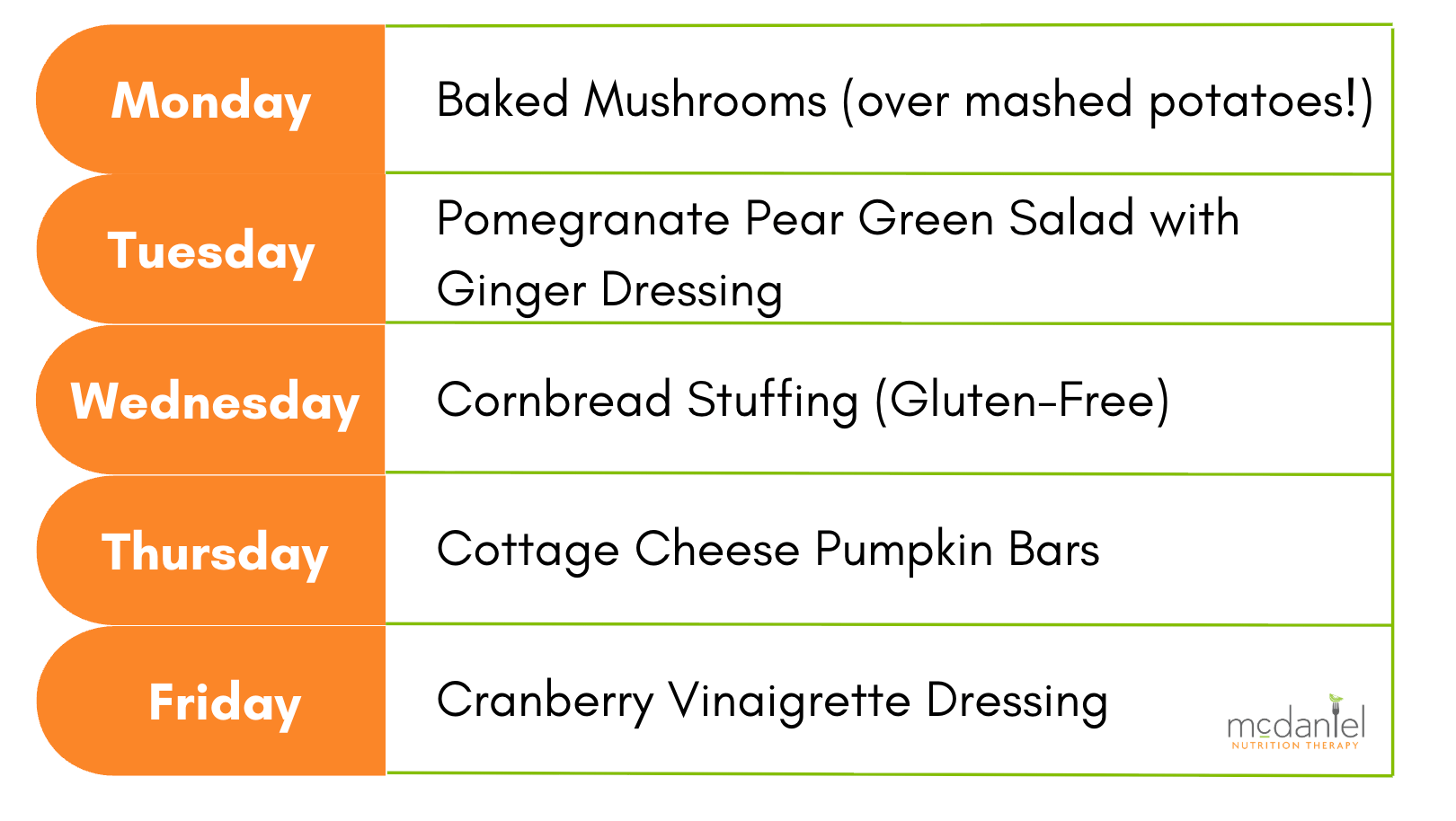
If it was Thanksgiving for “one”, these are a few items I would have on my Thanksgiving table + recipes to enjoy through the week. ;)
Monday
Baked Mushrooms with Miso: This dish is not only delicious but visually stunning. The savory miso glaze gives the mushrooms adds to the depth of flavor. She recommends serving them over mashed potatoes, and I 100% agree this is a good idea.

Tuesday
Pomegranate and Pear Salad with Ginger Dressing: Pomegranates are my favorite fall fruit, and their ruby-red color brings instant beauty to any plate, specially this salad. Light, fresh, and plant-forward, it adds balance to the heavier dishes on a Thanksgiving table.

Wednesday
Cornbread Stuffing (Gluten-Free): I’ve always loved both stuffing and cornbread, so this recipe feels like the best of both worlds. It’s a perfect combination that ensures our gluten-free guests feel fully included at the holiday table.

Thursday
Cottage Cheese Pumpkin Bars: Okay, this may not be the dessert I’d serve on Thanksgiving Day, but it would be the perfect nourishing snack during the holiday week, especially if you have extra canned pumpkin waiting to be used.

Friday
Cranberry Vinaigrette Dressing: Got leftover canned cranberry? This vinaigrette is one of my go-to sweet-tart dressings. With cranberry, Dijon mustard, and olive oil, it’s a bright, flavorful topper for almost any salad.
Have a wonderful holiday week friends! I am so grateful for our connections. XO -Jen
This was an amazing, and much-needed, piece. Thank you!