


Coffee lovers, don’t panic. You can keep your morning cup. But how you make it might matter more than you think.
Let me begin by reassuring you that you can still have your coffee!
I can’t exactly remember when I started drinking coffee, but I’m pretty sure it was in college with some kind of latte situation.
A funny sidenote: My college roommate, who was in nursing school, had been adding Bailey’s Irish Cream to her morning coffee for nearly an entire year before I alerted her that her morning java contained alcohol. As you might imagine, she was quite shocked by the news!
But back to my coffee…
A few years later in my coffee career, I decided that finding the right cream and honey concoction was becoming a bit too high-maintenance and challenged myself to the simplicity of just…coffee.
It took a good six months to fully embrace this unadulterated version, but now I wouldn’t have it any other way. Well, other than adding two scoops of collagen powder.
This morning ritual is 100% the highlight of my day.
So when a client told me about a year ago that she’d stopped drinking coffee because she’d heard it raised LDL cholesterol, I thought, Oh, right. Just like seed oils cause inflammation.
I’d been a dietitian for years, counseling people on heart health, and somehow this had never come up in my education or conversations with clients.
And frankly, I didn’t particularly want to investigate something that might threaten my favorite morning ritual.
But I was too intrigued not to look into it.
And it turns out, she was right.
But there was an important caveat.
How Can Coffee Raise Cholesterol?
When we talk about foods that raise LDL cholesterol, we usually focus on saturated fat: Butter, cheese, fatty meats, coconut oil. These are the foods that tend to dominate the conversation.
But coffee has an entirely different mechanism that has nothing to do with saturated fat.
Coffee beans naturally contain compounds called cafestol and kahweol, which belong to a group of plant compounds known as diterpenes.
These compounds are found in the oily portion of coffee and can affect how the liver regulates cholesterol.
Cafestol appears to be the primary cholesterol-raising compound, although kahweol may contribute.
Here’s the important distinction: The amount of these compounds that ends up in your cup depends largely on how your coffee is prepared.
Paper filters trap most of these oily compounds. Brewing methods that don’t use paper filters allow more of them into the finished coffee.
Not All Coffee Is Created Equal
If you’re drinking traditional drip coffee brewed through a paper filter, you’re already in pretty good shape from an LDL cholesterol perspective.
But other brewing methods allow more cafestol and kahweol to remain in the coffee.
Brewing Methods & Impact on LDL
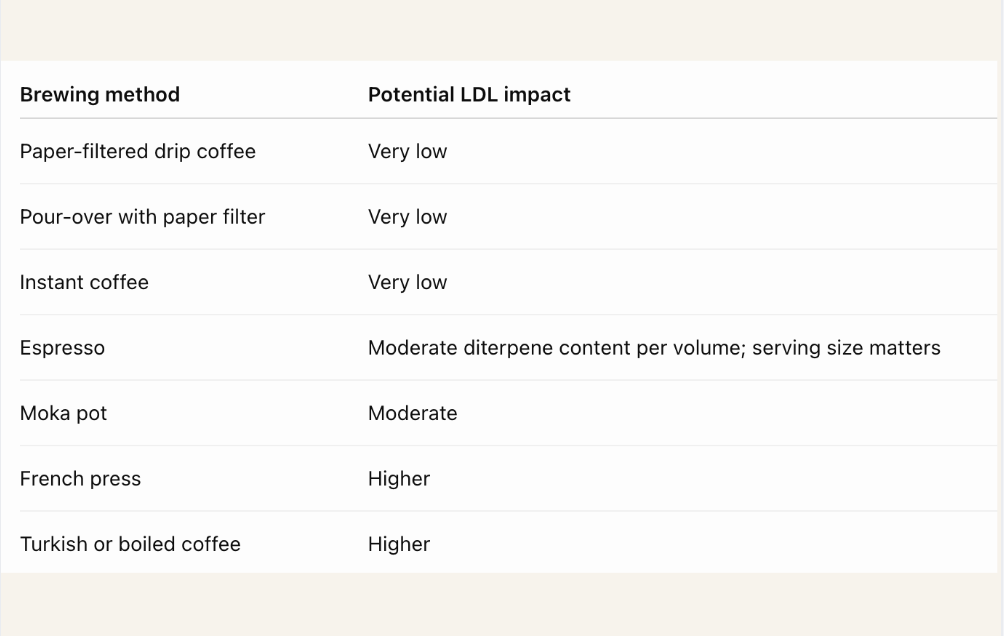
French press coffee is particularly interesting because it uses a metal mesh rather than a paper filter. While the mesh keeps most of the grounds out of your cup, it doesn’t remove the cholesterol-raising oils nearly as effectively.
And espresso? It contains these compounds, too, but because espresso is typically consumed in much smaller quantities, the total exposure may be considerably less than with several large mugs of French press coffee.
In other words, a single morning espresso isn’t necessarily something to worry about.
The bigger consideration is how much unfiltered coffee and how often you drink it.
Is the Research Actually Strong?
Yes! We have randomized controlled trials showing that unfiltered coffee can directly increase LDL cholesterol.
In fact, a meta-analysis of randomized trials found that drinking unfiltered coffee (a median of six cups daily) increased LDL cholesterol by approximately 15 mg/dL compared with filtered coffee.
That’s not insignificant, particularly for someone who already has elevated LDL cholesterol or other cardiovascular risk factors.
And here’s the good news: The research suggests that much of this effect can be avoided simply by using a paper filter. Also…6 cups is no small amount of coffee!
Since this effect isn’t caused by caffeine, decaffeinated coffee contain cafestol and kahweol, too. So switching to decaf doesn’t necessarily solve the problem.
And Then There’s What We Put In Our Coffee
There’s another way our daily coffee habit can affect LDL cholesterol, and this one is probably more familiar.
Creamers. Unlike cafestol and kahweol, which affect cholesterol through the coffee itself, many coffee additions contain saturated fat. And we have decades of research showing that replacing saturated fat with unsaturated fat can help lower LDL cholesterol.
Here’s how the saturated fat can add up, depending on what you’re pouring into your cup.
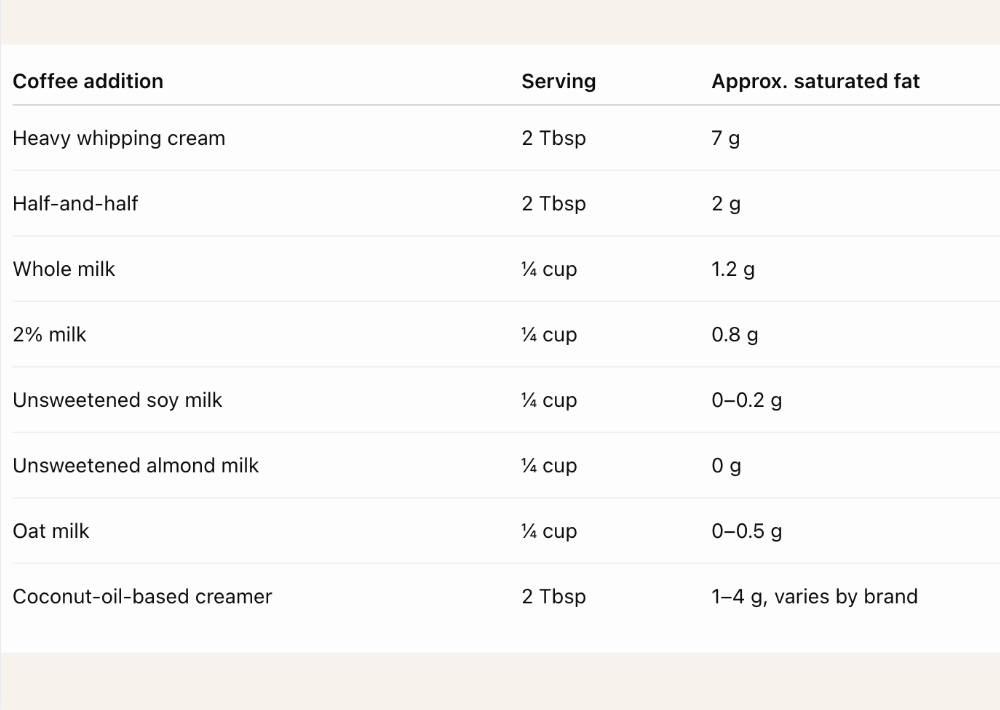
Approximate amounts; check individual product labels, especially for plant-based creamers.
For perspective, the American Heart Association recommends limiting saturated fat to less than 6% of total daily calories for people who need to lower LDL cholesterol.
For someone eating 2,000 calories a day, that’s about 13 grams of saturated fat.
Two tablespoons of heavy cream in your coffee could account for more than half of that amount before you’ve eaten breakfast.
And if you’re drinking multiple cups a day, those additions can really accumulate.
What’s also worth pointing out is that plant-based doesn’t automatically mean heart-healthier.
Some dairy-free creamers rely on coconut oil for their creamy texture, and coconut oil is particularly high in saturated fat.
So while the packaging may suggest a healthier alternative, the saturated fat content can sometimes rival dairy-based options.
And these are two completely separate issues.
You could drink black French press coffee and still be getting cholesterol-raising diterpenes.
Or you could drink perfectly paper-filtered coffee but add enough heavy cream that saturated fat becomes a consideration.
Or, of course, you could drink coffee in a way that raises neither concern very much!
Why Don’t We Hear More About This?
Coffee research is complicated. Coffee contains hundreds of biologically active compounds, and studies examining coffee consumption and overall health frequently find associations with favorable outcomes.
In fact, moderate coffee consumption has been associated with lower risks of several chronic diseases.
So the message that coffee can raise cholesterol seems almost contradictory.
But both things can be true.
Coffee can contain potentially beneficial compounds while certain preparation methods also deliver compounds that raise LDL cholesterol.
That’s why I think it’s important to distinguish between the effects of coffee on overall health and the specific effects of unfiltered coffee on LDL.
What Do I Recommend?
First, I wouldn’t tell someone to give up a coffee ritual they genuinely enjoy simply because they’re concerned about cholesterol.
I’d start by asking a few questions.
How are you brewing your coffee? How many cups are you drinking? And what, if anything, are you adding to it?
For someone with elevated LDL cholesterol, especially someone working toward a more aggressive LDL goal, switching from French press to paper-filtered coffee may be a simple change worth making.
If you’re an espresso lover, I’d consider the amount you’re drinking before making any sweeping recommendations.
And if you enjoy a creamy coffee, I’d look at the saturated fat content of your additions.
These are relatively small adjustments that don’t necessarily require giving up the experience you enjoy.
Always Learning
One of the things I continue to appreciate about nutrition science is that there’s always something more to learn.
Even after years of practicing as a dietitian, I still come across research that surprises me.
And sometimes it challenges something I personally enjoy. Dang.
But I don’t think the purpose of learning more about nutrition is to become increasingly fearful of what we’re eating or drinking.
It’s to become better informed.
I still love my morning coffee. And I have no intention of giving it up.
Fortunately, the way I prepare it already fits well with what we know about coffee and LDL cholesterol.
And if you’re someone who loves French press or a rich, creamy latte, I’m not suggesting that you abandon those pleasures either.
I’m simply sharing something I wish I’d known sooner.
Because sometimes protecting our health doesn’t require doing less of something we love.
Sometimes it just means making a few tweaks that become the new and beloved way.
Menu for the Week of November 2-6th
All the squashes for squash season!
Monday
Crispy Tofu & Delicata Squash Sheet Pan Dinner

Tuesday
Butternut Squash & Chicken Stir Fry

Wednesday
One Pot Coconut Curry Kabocha Squash Soup

Thursday
Greek Inspired Spaghetti Squash

Friday
Pumpkin Oat Muffins with Greek Yogurt

Happy Halloween, Friends!