


More and more, I’ve been getting questions about peptides.
Not just in my inbox, but from friends, colleagues, clients, and over on Instagram.
“What do you think about taking a peptide for…”
building muscle
reducing body fat
better sleep
improved mood
faster recovery
skin rejuvenation
My mind reached back, way back, to Chemistry I… or was it II?
Peptides? Aren’t those just small chains of amino acids from basic chemistry?
So how did something I remember from a college lecture suddenly become a very popular intervention in the wellness space and potentially a “solution” to so many challenges of aging?
After enough of these conversations, I decided to go back to the basics. I revisited the foundational science and started paying attention to what researchers are saying about this fast-growing category of therapies.
Let’s start here…
What Is a Peptide?
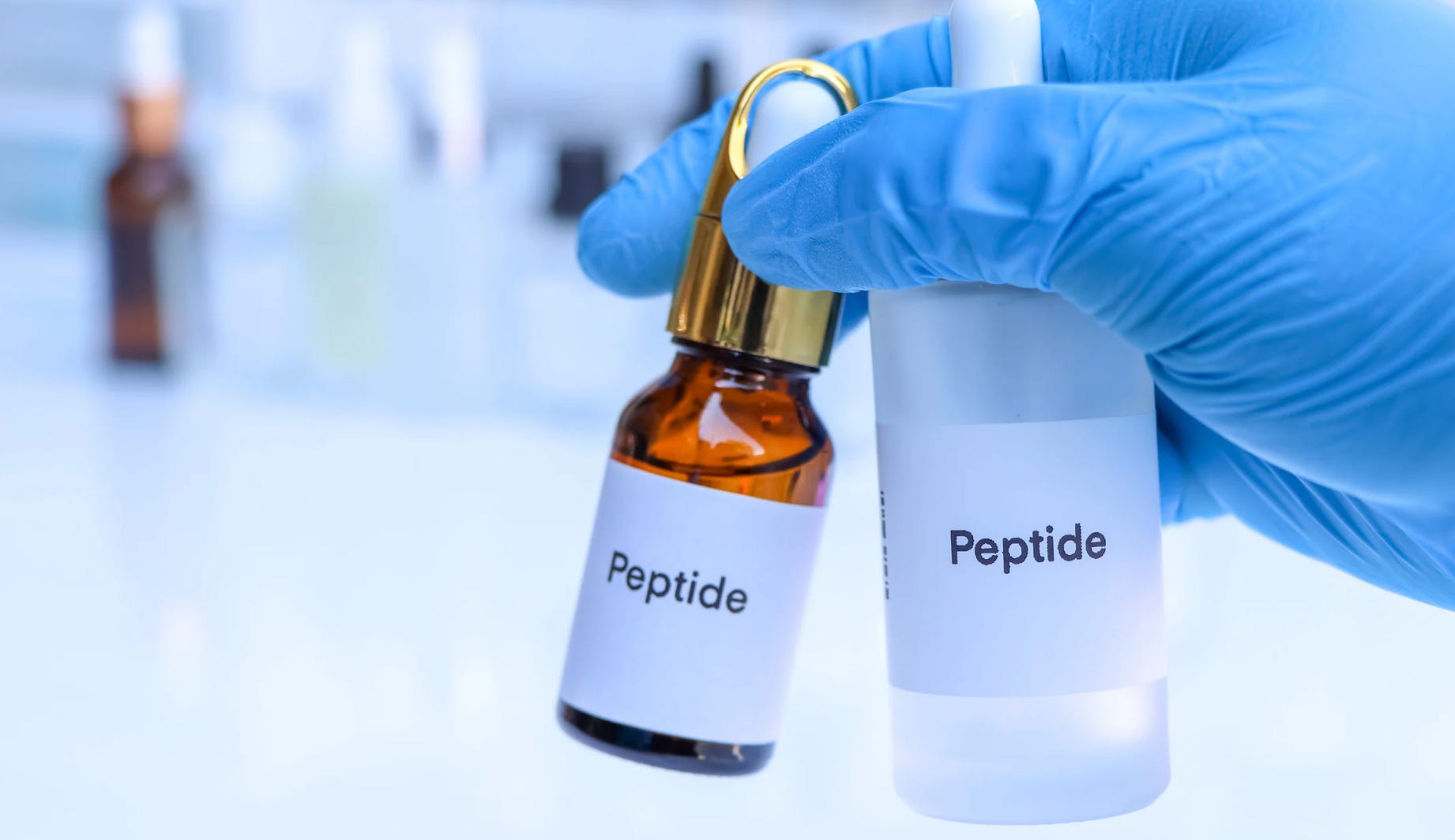
A peptide is a short chain of amino acids: the building blocks of protein. Our bodies make peptides which act as signaling molecules. Think of them as text messages between organs and tissues.
For example:
Insulin is a peptide hormone that regulates blood sugar.
Glucagon-like peptide-1 (GLP-1) is a peptide involved in appetite and glucose regulation.
Growth hormone–releasing hormone (GHRH) is a peptide that stimulates growth hormone release.
Natural peptides in the body are designed to act quickly and then get broken down, often within minutes. Modern medicine has learned how to modify certain peptides so they last longer. That’s how medications like GLP-1 receptor agonists work: they are engineered versions that remain active in the body long enough to create meaningful metabolic change. AND, FDA-approved GLP-1 medications have undergone extensive human clinical trials to evaluate both safety and effectiveness.
That level of testing and regulatory oversight simply hasn’t happened for many of the peptides currently being marketed for body composition or “anti-aging.”
The Peptide Drugs Being Marketed for “Optimization”
Here are a few commonly popular peptide drug examples:
CJC-1295
Marketed as: boosting growth hormone, building muscle, reducing fat, improving recovery.
What it is: a synthetic analogue of growth hormone–releasing hormone.
Most of the body composition data come from animal studies or extremely small human trials. There are no robust long-term studies in healthy adults using it for performance or aesthetics.
Ipamorelin
Marketed as: a “safer” growth hormone stimulator.
What it is: a growth hormone secretagogue that stimulates the pituitary gland.
Again, limited short-term data. No large-scale long-term safety trials in healthy adults using it for optimization.
BPC-157
Marketed as: healing gut lining, accelerating tendon repair, reducing inflammation.
What it is: a synthetic fragment derived from a protein found in gastric juice.
The majority of supportive research is in rodents. Human trials are sparse and small.
When these compounds are marketed, the language often sounds compelling:
“Repair.” | “Restore.” | “Rejuvenate.” | “Optimize.”
But stimulating growth hormone pathways or cellular repair mechanisms isn’t a light switch. Hormonal systems are deeply interconnected. When we artificially amplify one pathway, we can’t assume it exists in isolation.
We simply do not have strong, long-term data on what chronic manipulation of these pathways does in otherwise healthy adults.
That doesn’t automatically mean harm.
But it does mean uncertainty.
A Word About COMPOUNDED Peptides (Including GLP-1s)
Another important layer in this conversation is compounded medications. Some clinics offer compounded GLP-1s or other peptide injections when branded medications are expensive or in shortage.
Compounding pharmacies do serve an important role in medicine. They can create customized formulations when a patient needs a specific dose or has an allergy to an ingredient.
However:
Compounded medications are not FDA approved. They do not go through the same pre-market clinical trial process. They are not evaluated in large Phase 1, 2, and 3 trials before being offered to patients.
And they are not subject to the same large-scale manufacturing consistency standards required for brand-name pharmaceuticals.
When a medication is developed through the FDA pathway, it typically undergoes:
Preclinical laboratory and animal studies
Phase 1 trials (safety and dosing in small groups)
Phase 2 trials (expanded safety and early effectiveness)
Phase 3 trials (large randomized controlled trials, often involving thousands of participants)
Ongoing post-marketing surveillance
This process can take many years.
It is designed that way to clarify:
Mechanism of action
Appropriate dosing
Drug interactions
Short- and long-term safety
Rare but serious side effects
With compounded injectables, consistency and sterility rely heavily on the individual pharmacy’s processes.
This can mean that formulation, potency, or sourcing may vary from one batch to another. For a patient, that variability could translate into noticing different effects (or not getting an effect at all) and wondering why one vial feels different than the last.
For example, an Austin-based peptide testing company, Finnrick Analytics, analyzed over 5,000 samples of peptides from more than 170 vendors. They found substantial variability, not just between companies, but between batches from the same vendor. In testing of BPC-157, some vials labeled as the peptide didn’t contain the compound at all. In others, purity ranged from about 82% to 100%.
This doesn’t mean every compounded medication is unsafe. It does mean the regulatory pathway is more limited, particularly when products are sold outside of traditional FDA oversight.
And when we are talking about injectable substances that influence hormonal signaling, precision and sterility are not minor details.
Questions Worth Asking On Behalf Of Your Body
If someone recommends a peptide for muscle, fat loss, mood, or recovery, it’s reasonable to ask:
Has this been studied in large human trials?
What are the long-term safety data?
Is it FDA approved for this use?
Is it compounded? If so, what quality controls are in place?
What happens when I stop taking it?
What other hormonal systems could be affected?
If those answers are unclear, it’s not because you’re asking the wrong questions…more that…the data simply does not yet exist. And without that data, we are, in many ways, participating in an experiment.
I Support Innovation.
I support exploring new pathways and thoughtfully considering what might work for our bodies, especially when we aren’t feeling ourselves. It is wonderful and good to advocate on behalf of our health.
But there is a difference between carefully studied innovation and market-driven acceleration.
Our bodies aren’t a beta test.
And right now, there is significant financial incentive driving the rapid expansion of these therapies. I’ve personally received emails promoting the opportunity to make $20,000 a month by adding certain peptides into our practice.
That doesn’t automatically make something wrong.
But it should make us pause.
Because we deserve:
Transparency
Evidence
Clear risk discussions
Long-term human data
Before we inject, ingest, or invest.
Optimization culture often promises shortcuts. Physiology rarely offers them without tradeoffs. And before injecting anything into our body in the name of muscle, mood, or metabolism, we can ask informed questions.
And make sure the excitement around something new doesn’t outpace the evidence supporting it.
Menu for the week of March 9-13th

Monday
Chickpea + Edamame Wrap: I often get questions about lunch ideas beyond the standard deli sandwich. This wrap checks the boxes for both fiber and protein and therefore… satiety.

Tuesday
Mediterranean Lamb Bowls: I’m not personally a lamb fan, but that doesn’t mean you won’t be! I try to think outside my own preferences, and this one got rave reviews.

Wednesday
One Pot Lemon Chicken & Orzo: A solid option for a quick weeknight dinner with minimal cleanup. Bright, simple, and family-friendly.

Thursday
Crock Pot Pork Roast with Mushrooms: Served over creamy polenta and paired with mushrooms, this one leans into comfort. We’re still very much in winter mode here in the Midwest, one gray sky after another, so this feels fitting.

Friday
Kiwi Smoothie: Use the milk you prefer, and don’t forget, you can wash the kiwi and toss the whole thing (skin included!) into the blender for an extra fiber boost.

XO Jen