


You get what you get, and you don’t throw a fit.
I’m not a short-order cook.
One meal for the whole family.
These are some of the familiar phrases that shape how we think family dinner is supposed to work: one person makes the meal, and everyone else eats it.
And there is something reasonable underneath that expectation. Making dinner is already a considerable task. Making several different dinners to satisfy every preference at the table is simply not realistic.
But as a parent trying to feed a family with different tastes, appetites, and ideas about what sounds good, I’ve found that “one meal for the whole family” isn’t always as straightforward as it sounds.
A recent conversation with a client made me think about the other side of this.
She was describing how meals work in her home. Her husband does most of the shopping and cooking, and she has noticed that she tends to eat around his preferences. She enjoys a wider variety of vegetables and other foods than he does, but because he is doing the work of getting dinner on the table, she feels as though she should simply go along with whatever he wants.
As we talked, she wondered aloud whether this might go all the way back to childhood. Her parents’ approach was essentially, This is what we’re eating. There wasn’t much room for her to have a preference, or at least to express one.
And I thought: Well, yes. In many ways, that’s exactly what we were taught family meals were supposed to look like.
The quieter rule we’ve held onto…
The intention made sense. But the rigidity didn’t always serve families well.
Most families today probably aren’t sitting down to dinner saying, This is what I made. Eat it or go hungry. If anything, many parents are doing the opposite, thinking constantly about what everyone will eat and sometimes bending over backward to make it happen.
Still, a quieter version of that old rule may remain: A successful family meal is one where everyone eats the same thing.
And when that doesn’t happen, a little guilt can creep in.
Am I catering too much?
Am I making my child picky?
Should I just tell them this is what’s for dinner?
This may be where the old advice deserves a little flexibility.
No one needs to make four separate dinners. And exposing kids to a wide variety of foods still matters. They don’t have to eat those foods, or even take one bite, for the exposure to count. Seeing foods repeatedly and watching other people enjoy them are also part of learning to eat.
But exposure doesn’t require everyone to eat the same thing.
Maybe family dinner can have a shared structure without requiring a shared plate.
A shared structure, not a shared plate
My middle son helped me understand this when he was younger. If there wasn’t something on the table he felt he could eat, he would become incredibly frustrated. And this is a child who has never shied away from letting me know what’s up.
I understand that frustration much better now.
How many times have you been really hungry, looked at the available options, and thought, There is nothing here I want, or feel able, to eat?
That’s a hard place from which to approach a meal, whether you’re a child or an adult.
That doesn’t mean we have to continually remove unfamiliar foods or build every meal around the most selective eater. If we do that, we may unintentionally make their world of food smaller.
There’s still tremendous value in putting different foods on the table without requiring kids to eat them.
One of the principles I learned from pediatric feeding expert Ellyn Satter was to include something familiar at the meal.
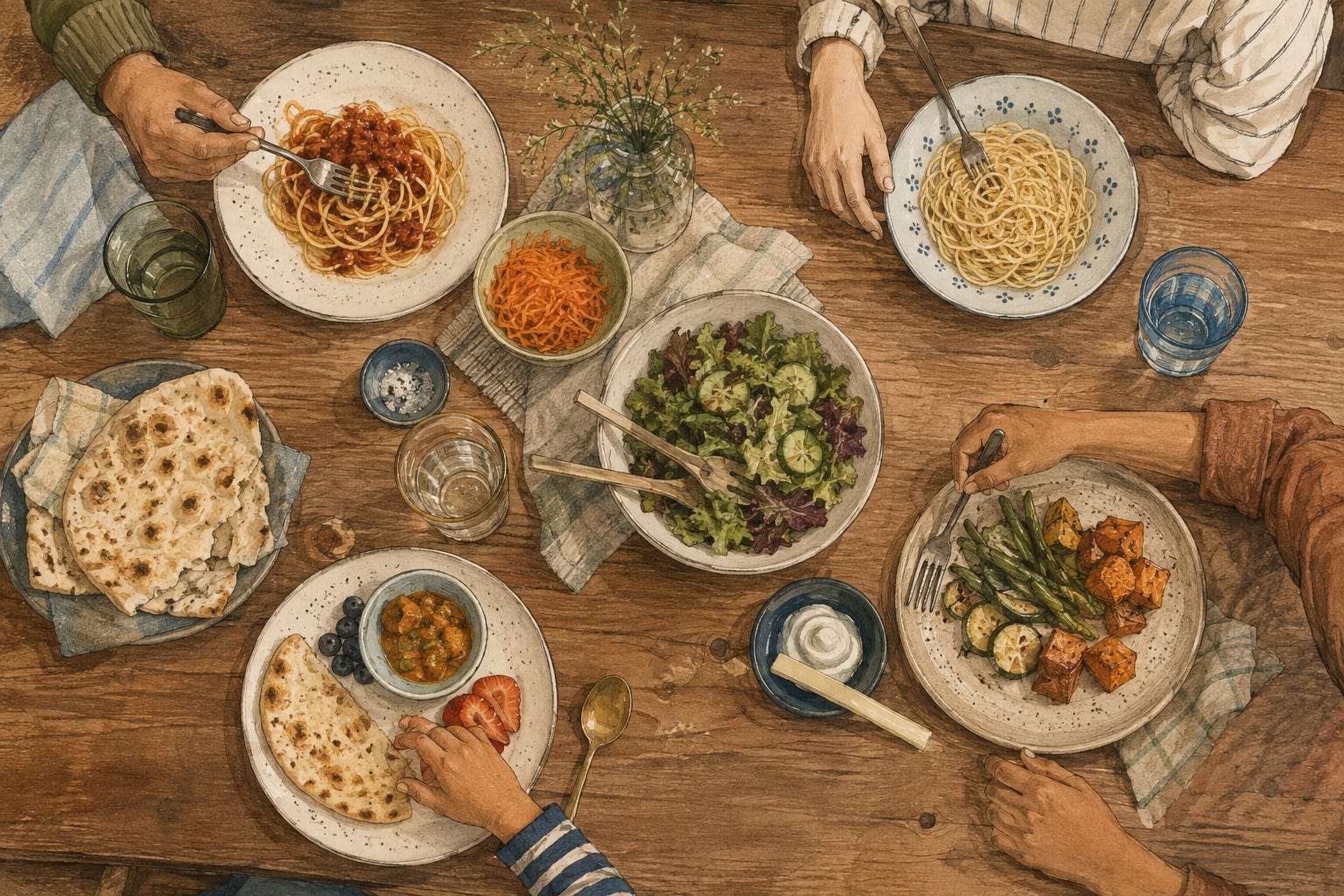
So maybe tonight’s dinner is chicken curry, naan, fruit and vegetables. Your child can’t quite wrap their head around the curry yet, but they love the naan and fruit. They eat those and ask, Can I get a cheese stick too?
Sure.
The meal doesn’t have to become a battleground, and you don’t have to go back into the kitchen and cook another dinner.
Maybe another night everyone is eating pasta with meat sauce. One child wants plain noodles. Someone else adds parmesan but no sauce. Another person wants more vegetables. Maybe somebody grabs a yogurt to go with what they’re eating.
We’re still having dinner together.
And perhaps that’s the part we’ve confused a little over the years: family dinner doesn’t necessarily mean everyone eating exactly the same food.
One table, with room for everyone
Of course, one of the best ways to help kids become more interested in food is to involve them in the process. Let them choose something at the store. Ask what vegetable sounds good this week. Invite them to make something with you.
And as a mother, I also know that have your kids help you cook! can quickly become one more thing we should be doing.
So maybe it’s just an invitation when there’s time. A Saturday afternoon instead of a Tuesday at 5:45 pm.
Over time, those small invitations may expand what everyone eats and make the mythical one family meal a little easier to pull off.
The original advice wasn’t entirely wrong. Parents don’t need to become short-order cooks. Kids benefit from being around foods they wouldn’t necessarily choose themselves. And sometimes accommodating every preference can become exhausting for everyone involved.
But maybe we don’t need to turn those ideas into another rigid rule about what dinner is supposed to look like.
Maybe the goal was never really one meal, no exceptions.
Maybe it was one table, with room for everyone at it.
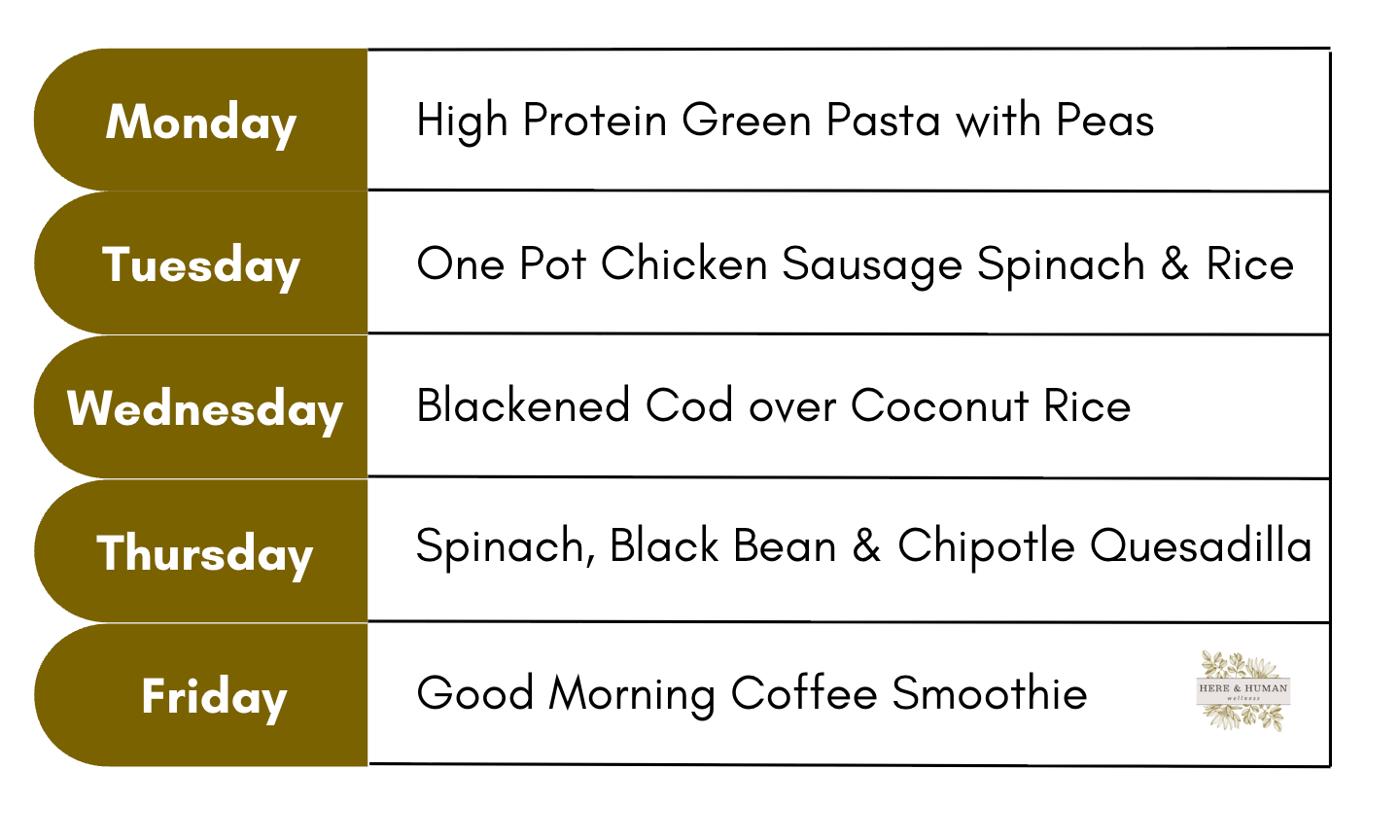
Menu for the Week of September 7-11th
Monday
High Protein Green Pasta with Peas (this was actually way easier than I thought and very tasty!)

Tuesday
One Pot Chicken Sausage, Spinach & Rice

Wednesday
Blackened Cod over Coconut Rice

Thursday
Spinach, Black Bean & Chipotle Quesadilla

Friday

XO - Stay Cool, friends. Fall must be on the way soon?