


One of the most helpful things I’ve started doing is treating my annual OB/GYN visit like a yearly field note instead of simply a yearly check-up.
Who knows if I’ll remember to do this every year, but at the current moment…I’m thinking it could become an annual tradition.
There are so many stories about perimenopause, and no two seem to be exactly alike. Maybe these yearly notes will help me notice patterns over time. And maybe they’ll reassure another woman that there isn’t one “right” way to move through this transition.
At the time of this year’s visit, I’m 48 and 1/2.
Wouldn’t you agree that it can be surprisingly difficult to know:
Is this perimenopause-related?
Or is this just the gift of simply getting older?
Thankfully, women today have access to far more information than previous generations ever did. Along with growing research has come greater awareness, and I think that’s a wonderful thing. More women are asking thoughtful questions and taking an active role in understanding their health.
At the same time, with more information comes the temptation to attribute every new ache, mood shift, or frustrating day to perimenopause.
Sometimes that’s true.
Sometimes it isn’t.
That’s one reason I jot down “symptom” notes in my phone. By the time my annual appointment rolls around, I tend to forget half the things I meant to mention. Whether it’s white coat syndrome or simply the pace of life, having a running list makes conversations with my physician much more productive.
What has mostly shown up as a symptom is MOOD.

I love roller coasters…just the mood swings they sometimes look and feel like.
Before I get there, here’s where things currently stand.
I’m sleeping well, which I know plays a significant role in emotional well-being. I’m not experiencing regular hot flashes or night sweats. My menstrual cycles are also still regular, suggesting my ovaries are continuing to produce estrogen consistently.
Heart health also came up.
Because I have a strong family history of cardiovascular disease, and elevated lipoprotein(a), it’s something I pay close attention to. I currently take 20 mg of Crestor. While statins don’t lower lipoprotein(a), they do reduce LDL cholesterol, which becomes increasingly important for someone with elevated cardiovascular risk.
As estrogen declines during menopause, LDL cholesterol often rises as well. That doesn’t automatically mean hormone therapy is necessary, but it does mean these conversations become more individualized. Since my cycles remain regular and I’m not experiencing symptoms that suggest I’m further along in the menopausal transition, this wasn’t the time for us to consider that discussion.
A couple of years ago, around age 46, I also had a baseline DEXA scan. As estrogen declines, bone loss accelerates, making this an important time to focus on the things we can influence: eating enough, consuming adequate protein, getting enough calcium and vitamin D, and continuing resistance training to support bone health.
Fortunately, my scan looked good, and for now we don’t plan to repeat it for another year.
Now, back to the mood...
What I notice most consistently is that around ovulation, and even more so during the few days before my period, my emotional resilience seems to shrink.
It’s more than simply feeling irritable.
Things that would normally roll off my back can suddenly feel much bigger. I find myself wanting more space from my family. Small disappointments can unexpectedly bring me to tears. Sometimes I feel overwhelmed by emotions that, a week earlier, I would have moved through fairly easily. And occasionally, I simply don’t feel like doing the ordinary things I’d normally enjoy.
If I had to rate these symptoms on a scale from 0 to 10, I’d rate them at about a 5 or 6.
P.S. I find that using a simple numerical scale like this can make it easier to notice subtle changes in how you're feeling over time.
Whether these mood shifts represent the earliest hormonal changes associated with perimenopause, longstanding PMS that I’m simply noticing more, or something else entirely is difficult to know. That’s exactly why I think tracking symptoms over time can be so valuable.
The reason I don’t rate them higher is that they’re usually short-lived, and over the years I’ve found things that genuinely help: protecting my sleep, going for my daily walks, and keeping the habits that help my nervous system feel steady.
But something else has shifted too: I’ve stopped expecting myself to have the same capacity every day of the month.
There are times, particularly when I’m very tired or in those few days before my period, when life simply feels more raw. My emotions are closer to the surface, and I notice I have less capacity to keep everything feeling organized inside. Thoughts feel louder. Emotions move through me more intensely. The version of me that usually keeps everything running fairly smoothly just isn’t as available.
Years ago, I would have worked really hard to get back to feeling like “myself” as quickly as possible. When that extra capacity isn’t there, I can’t manage my experience in quite the same way. I can’t smooth over every feeling or convince myself that I should be okay. And strangely, I’m not sure that’s entirely a bad thing.
It doesn’t necessarily feel peaceful. Sometimes it feels incredibly vulnerable. But it also feels more honest. More immediate. It’s as if there are fewer layers between what’s happening and my attempt to manage what’s happening.
Perhaps this is one of the quieter invitations of perimenopause. Not simply to notice changing hormones, but to notice how much energy I’ve spent trying to keep myself together. And maybe, every once in a while, to discover that it’s okay when I can’t.
What the Doc Said
For the past two years, I’ve brought these mood changes up with my physician. Both years she mentioned an option I hadn’t previously considered: using an SSRI antidepressant (such as fluoxetine/Prozac or sertraline/Zoloft) only during the portion of the menstrual cycle when symptoms are most disruptive.
After our visit, I looked more closely at the evidence. Interestingly, research supports this approach for some women with moderate to severe premenstrual symptoms or PMDD. Unlike treating depression, where SSRIs often take several weeks to work, these medications appear to reduce PMS and PMDD symptoms much more quickly. Some women take them every day, while others take them only during the luteal phase, the approximately two weeks before their period, or beginning when symptoms start each month.
For me, because my symptoms are moderate and relatively brief, I’ve chosen to continue relying on lifestyle strategies for now. But I appreciated knowing this is an evidence-based option should my symptoms become more disruptive in the future.
What I’m taking away from this year’s visit
This stage of life feels like an invitation to pay attention, not with fear, but with curiosity.
I’ll plan on keeping a running list in the Notes app on my phone to bring these observations to my annual appointment.
Things worth jotting down before your annual visit
Changes in cycle length or bleeding
Mood patterns
Sleep quality
Hot flashes or night sweats
Energy levels
Brain fog or concentration
Joint aches
Vaginal or urinary symptoms
Libido
Exercise recovery
Questions that come up throughout the year
I’m looking forward to seeing what 49 looks like, not because I’m hoping for any particular outcome, but because every season has something to teach us.
Perhaps that’s the real value of paying attention: noticing patterns, asking better questions, and partnering more thoughtfully in our own care.
Menu for the week of July 13-17th
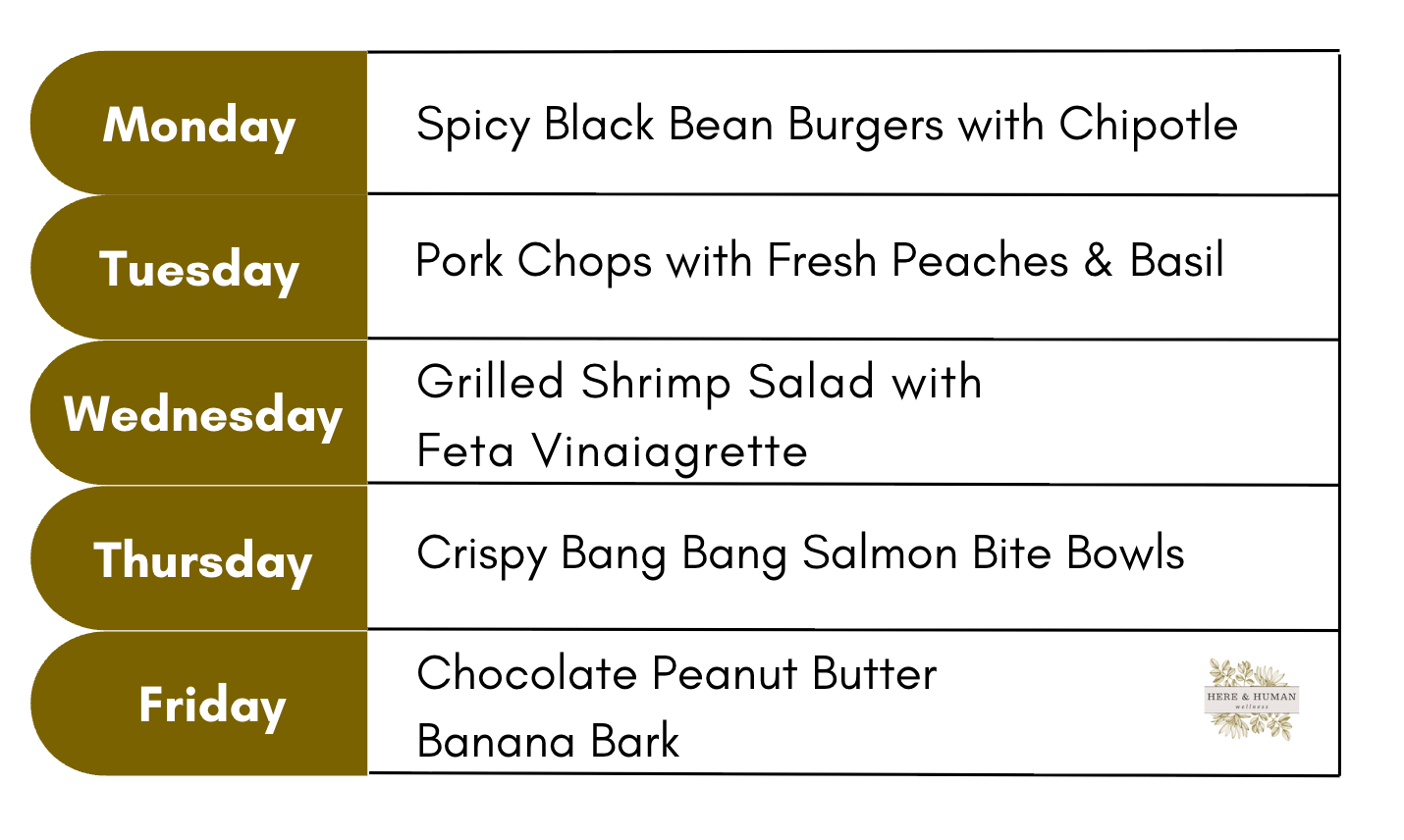
Monday
Spicy Black Bean Burgers with Chipotle

Tuesday
Pork Chops with Fresh Peaches and Basil

Wednesday
Grilled Shrimp Salad with Feta Vinaigrette

Thursday
Crispy Bang Bang Salmon Bite Bowls

Friday
Chocolate Peanut Butter Banana Bark

Happy Summer! XO Jen