


This week I gave a corporate wellness presentation on the topic of “food noise.” Five years ago, “food noise” didn’t seem to be a thing. But I would imagine there are very few people today who haven’t come into contact with this label.
To land us all on the same ground, food noise is often described as persistent thoughts about food: what to eat, what not to eat, when to eat, whether you should eat, or whether you ate too much.
In most conversations, food noise is treated as something inherently negative. How can I get rid of it? Why? Because food noise feels distracting. Because food noise might lead to unwanted behaviors like eating when we’re not hungry or eating the thing we told ourselves was bad.
So it makes sense that people want to figure this out or make it go away. But as I worked on the slides for this presentation and reflected on the topic during my morning walk, I found myself wondering: Are we moving too quickly to label every thought about food as a problem?
Of course, for many, food thoughts can feel disruptive. They might stem from years of dieting, voices of a parent or coach in their head, confusing nutrition messages, rigid food rules, or behaviors or restriction or overeating. When the thoughts come, they might make someone feel anxious or restless. In short, they are thoughts taking up more mental real estate than they deserve.
But not all attention directed toward food is evidence that something is wrong.

The Wisdom of the Body
Sometimes what we call food noise is simply the body doing what it was designed to do.
When we go too long without eating, we become hungry. When we’ve had enough, we become full. When we’ve trained hard, we often want more food. When we’ve been restricting, whether physically or mentally, our minds may become more preoccupied with eating.
These aren’t malfunctions. They’re valuable pieces of information.
The body is remarkably intelligent. More often than not, it is doing exactly what it was designed to do.
What often creates distress isn’t the signal itself, but the story we tell about it.
A hungry stomach becomes an inconvenience.
A craving becomes evidence of poor willpower.
Feeling full becomes proof you’ve eaten the wrong amount.
Interest in a pleasurable food becomes something to suppress.
Food Noise Suppression with GLP-1
Recently I read an article by Charlotte Markey discussing the experience some people have while taking GLP-1 medications. Many individuals describe a welcome reduction in food noise, and for some this is profoundly helpful.
At the same time, others describe something more complicated. They report feeling less enjoyment around food, less connection to hunger, uncertainty about when to eat, or difficulty interpreting body cues that once felt familiar. This could lead to declining a night out to dinner with girlfriends, challenges in meal planning because nothing sounds good, or feeling guilty because you know you need the calories and protein to support your training but lack the intrinsic cues to fuel correctly.
Both experiences deserve curiosity rather than judgment.
The Difference Between Noise and Information
But it raises an interesting question:
In our effort to quiet food noise, are we sometimes dismissing the wisdom contained within the signals themselves?
What if a strong craving is occasionally pointing toward deprivation?
What if it is revealing that you’ve been limiting yourself more than you realize?
What if persistent thoughts about food are revealing that you’ve gone too long without eating? And, skipping lunch actually backfires?
What if the answer isn’t always to silence the signal, but to understand it?
I am not arguing against medications. Nor am I suggesting that every thought about food deserves attention.
What I am questioning is our tendency to assume that thoughts automatically mean something needs fixing.
Thoughts are what brains do.
Bodies provide information.
The two aren’t always saying the same thing.
Sometimes I’ll ask clients a simple question:
What if your thoughts were in a language you couldn’t understand?
What if you could only listen to your body?
How would it guide your next decision?
Perhaps the goal isn’t the complete absence of food thoughts, nor is it labeling every thought as noise.
Perhaps the goal is being able to hear our body’s signals without fear, judgment, or the belief that something has gone wrong.
Cutting through unnecessary food noise may be wise.
Cutting ourselves off from the body’s intelligence is something else entirely.
That feels like a different conversation entirely.
Menu for the Week of June 29th-July 3rd
This week’s menus were inspired by real client conversations. One client needed breakfast ideas that could be made ahead, heated up, and eaten on the go. Another wanted a satisfying lunch bowl to pack for work. And one of my athletes—a runner—was looking for ways to prep smoothies in advance so he could fit in a quick breakfast and gradually train his stomach to eat more before the school year starts. These recipes are designed to make healthy eating a little easier, no matter what season of life you're in.
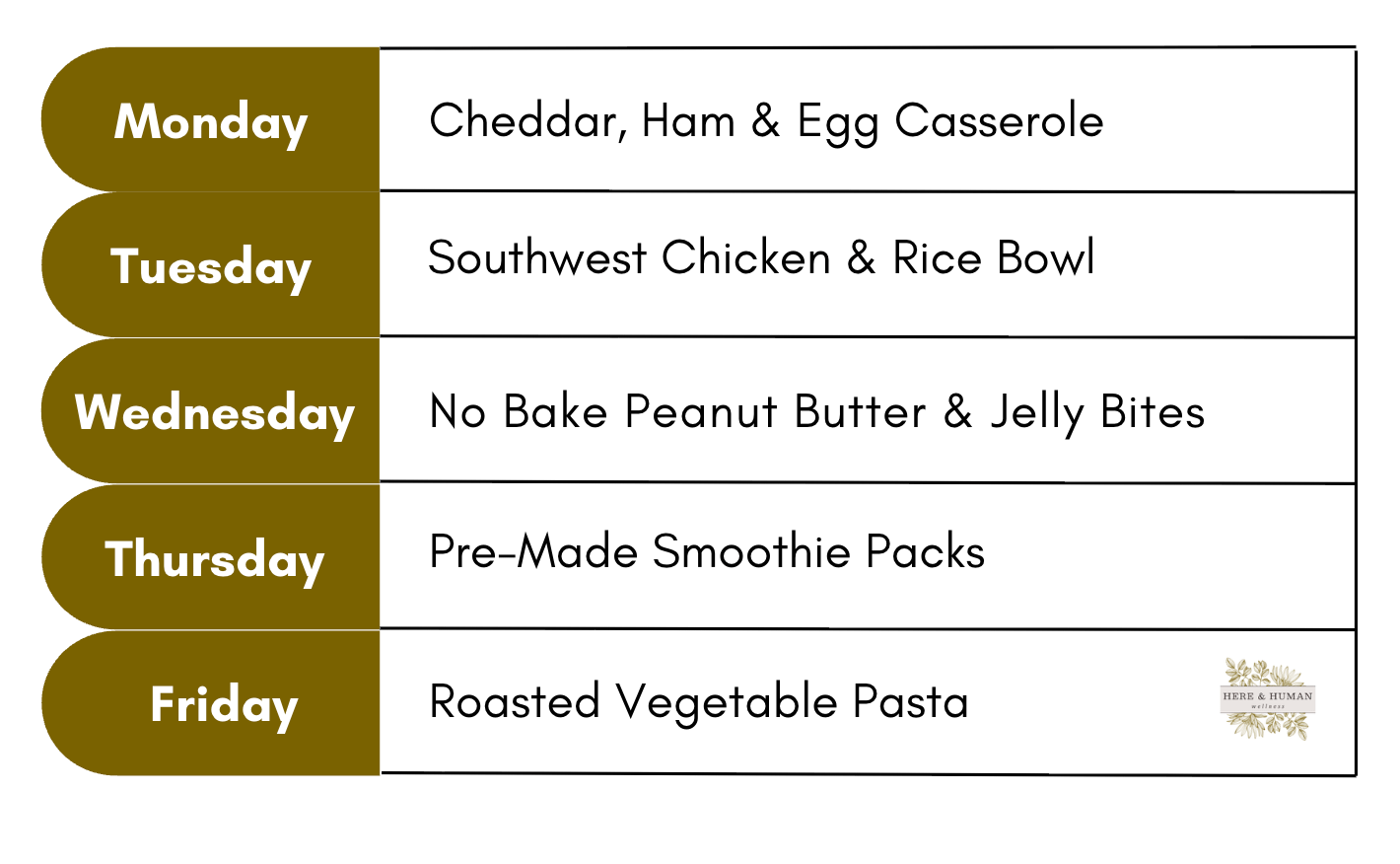
Monday

Tuesday

Wednesday
No Bake Peanut Butter & Jelly Bites

Thursday

Friday

Happy July 4th weekend, friends! Warmly, Jen