


I am going to try and always read these…personally, I have found I cannot listen to the robotic substack reader and retain the content! Mine might not be perfect, but I am definitely less robotic!
I felt like… talking bones was appropriate for Halloween, along with some scary, non–evidence-based nutrition advice!
A couple weeks ago, I had a discovery call that we often do in our private practice for clients to see if we might be a good fit for them. A woman in her mid-70s reached out after being diagnosed with osteoporosis and wanted to see if we could help her as she was feeling both overwhelmed and confused.
She had just come from meeting with a functional practitioner who used a device that involved placing her hand on a scanner and then speaking into it. The machine supposedly told her what was “wrong” with her body and advised her to avoid gluten, dairy, and nearly every food with oxalates (Oxalates are natural compounds in many plant foods that can bind minerals like calcium and, in some people, play a role in kidney stone formation).
By the time we spoke on this call, her diet was reduced to a handful of “safe” foods. No dairy, no gluten, no high-oxalate plants (which, by the way, includes spinach, nuts, and berries). In short…she wasn’t eating much of anything. Not a great way to support bones or ANYTHING.
As she shared her story, I felt two things at once: compassion for how overwhelming a new diagnosis can feel, and frustration that she had been given fear-based, non-evidence-based guidance from a tool claiming to diagnose her through her hand and voice.
As for what we could offer? “Our approach at McDaniel Nutrition isn’t about restriction. It’s about expanding your diet in a way that supports both your bones and your muscles. Evidence-based. Do-able. And, we will follow along with you to make sure that progress is made.”
Her story inspired me to take a fresh look at what the current science really says about nutrition, exercise, and bone health.
First, let’s talk about oxalates
Why do we care about oxalates? Oxalates in foods like spinach, almonds, and beets can bind to calcium. And calcium is the main mineral in bones. But here’s the nuance: if you’re getting enough calcium overall, oxalates aren’t a bone health villain. In fact, pairing calcium-rich foods with higher-oxalate foods (say, spinach + feta, or berries + yogurt) actually reduces kidney stone risk while still giving you all the plant nutrients.
So unless you’ve been specifically told otherwise by a kidney doctor, there’s no reason to cut out big swaths of healthy plant foods that contain these compounds.
Dairy: the MVP of bone nutrition
Dairy is often villainized in the wellness space. And if you’re truly lactose-intolerant? That makes sense. But if you tolerate dairy, it offers calcium, protein, and potassium in a form that is highly bioavailable. For women over age 50 and for men over age 70, the recommended daily intake of calcium (from food + supplements) is 1,200 mg. For younger adults, it’s 1,000 mg. Office of Dietary Supplements
If you tolerate dairy, a cup of milk or yogurt is an easy, efficient way to check a lot of those boxes.
Non-dairy but still bone-smart
Can’t or don’t want to do dairy? No problem. Here are other foods to lean on:
• Fortified soy milk (choose one with calcium carbonate; shake the carton before pouring).
• Calcium-set tofu, canned salmon or sardines with bones, 5–6 dried prunes, bok choy, kale and collard greens, fortified orange juice, sesame seeds/tahini.
• Chia seeds, white beans, almonds (in smaller portions) all contribute additional calcium in plant-rich diets.
These foods help make calcium more accessible when dairy isn’t part of the plan.
A note on greens & calcium
All leafy greens are nutrient-dense and offer fiber, vitamins, and antioxidants. Some (like spinach and beet greens) are higher in oxalates, meaning their calcium is less well absorbed, but that doesn’t make them off-limits. Instead, if you want to boost calcium with minimal fuss, focus on greens that are both calcium-rich and low in oxalates such as bok choy, kale, collards, and broccoli rabe. Meanwhile, still enjoy spinach or chard for their other benefits, just don’t rely on them as your primary calcium source.
Protein: the quiet hero
Protein is just as important for bones as calcium. It supports the muscles that protect your skeleton and reduces fall risk.
Older adults do best with 1.0–1.2 g of protein per kilogram body weight per day. Higher protein doesn’t harm bone health, it actually supports it when calcium is adequate.
What about protein timing?
For muscle health, spreading protein more evenly across meals (about 25–30 g at breakfast, lunch, and dinner) can help maximize one’s intake. For bones specifically, we don’t yet have strong studies showing distribution matters, the clearest evidence is that total daily protein is what counts. That said, keeping protein steady throughout the day supports muscle, which in turn supports bone.
Fruits & veggies: colorful allies
Produce provides vitamin C (collagen synthesis), vitamin K (bone metabolism), potassium (alkaline balance), and phytochemicals. Diets high in fruits and vegetables consistently correlate with better bone density.
A couple of standouts:
• Prunes (dried plums): Eating 5–6 prunes per day has been shown in clinical trials to preserve bone density in postmenopausal women.
• Low-oxalate greens like kale, bok choy, and collards (extra efficient for calcium).
• Citrus and berries for vitamin C.
• Mushrooms exposed to sunlight for vitamin D.
Exercise: the other half of the equation
Bones respond to stress , in a good way. Two pillars matter most:
1. Resistance training (2–3x/week, challenging loads for large muscle groups).
2. Weight-bearing impact (brisk walking, stairs, gentle jumps, if safe).
Balance practices like tai chi reduce fall risk. Weight lifting (even heavy lifting) can be safe and effective for postmenopausal women when properly supervised.
Weighted vests: do you need one?
At the recent North American Menopause Society meeting, (Beavers et al., 2025) it was shown that a weighted vest alone did not offset hip bone loss in older adults underscoring that the vest is not a standalone solution in the menopausal bone-health context. They are certainly not a substitute for strength training. Think of them as “bonus loading”…useful if you already have a solid movement base.
What doesn’t serve your bones
• Excess alcohol: More than 1 drink/day for women or 2 for men can hurt bone health.
• Smoking: Accelerates bone loss.
• Very high sodium or caffeine: Only an issue if your calcium intake is poor.
Supplements: practical, not obsessive
This is where my own mom’s story comes in. When she was diagnosed with osteoporosis, she was so diligent, counting every milligram of calcium, tracking supplements, pouring enormous energy into “bone protection.” I admired her effort, but I also worried the stress level created by all this work wasn’t sustainable or helpful.
Here’s a simplified guide:
Calcium
• Goal: 1,000–1,200 mg/day (food + supplements).
• Carbonate: take with meals. Citrate: can take with or without meals.
• Limit each dose to ≤500–600 mg for best absorption.
Vitamin D3
• Most adults with osteoporosis need 800–1,000 IU/day (tailor to bloodwork).
• Take with your largest, fat-containing meal.
Magnesium
• Many people fall short. Aim for 100–350 mg/day (from food + supplements).
• Glycinate or citrate forms are gentler than oxide.
Vitamin K
• Food first: leafy greens and fermented foods.
• If you’re on warfarin, keep intake consistent.
Optional add-ons
• Collagen peptides (5 g/day): modest Bone Mineral Density (BMD) support in studies.
• Creatine (with resistance training): supports muscle, reduces fall risk.
Don’t forget testing
A DXA scan (bone density test) is the gold standard.
• Recommended for all women ≥65, men ≥70, or younger adults with risk factors.
• Medicare usually covers every 2 years. If not, many centers offer cash pricing around $100–$250.
Knowing your numbers removes the guesswork.
Bringing it home
Back to the woman I spoke with: we began the work of rebuilding her plate. We added fortified soy, built protein into each meal, paired higher-oxalate foods with calcium instead of banning them, and focused on walking + resistance training rather than restriction.
We simplified her supplements into a short, doable list. And most importantly, we swapped fear with freedom.
Because bones don’t just need calcium…they need confidence, nourishment, and a lifestyle that strengthens the whole body.
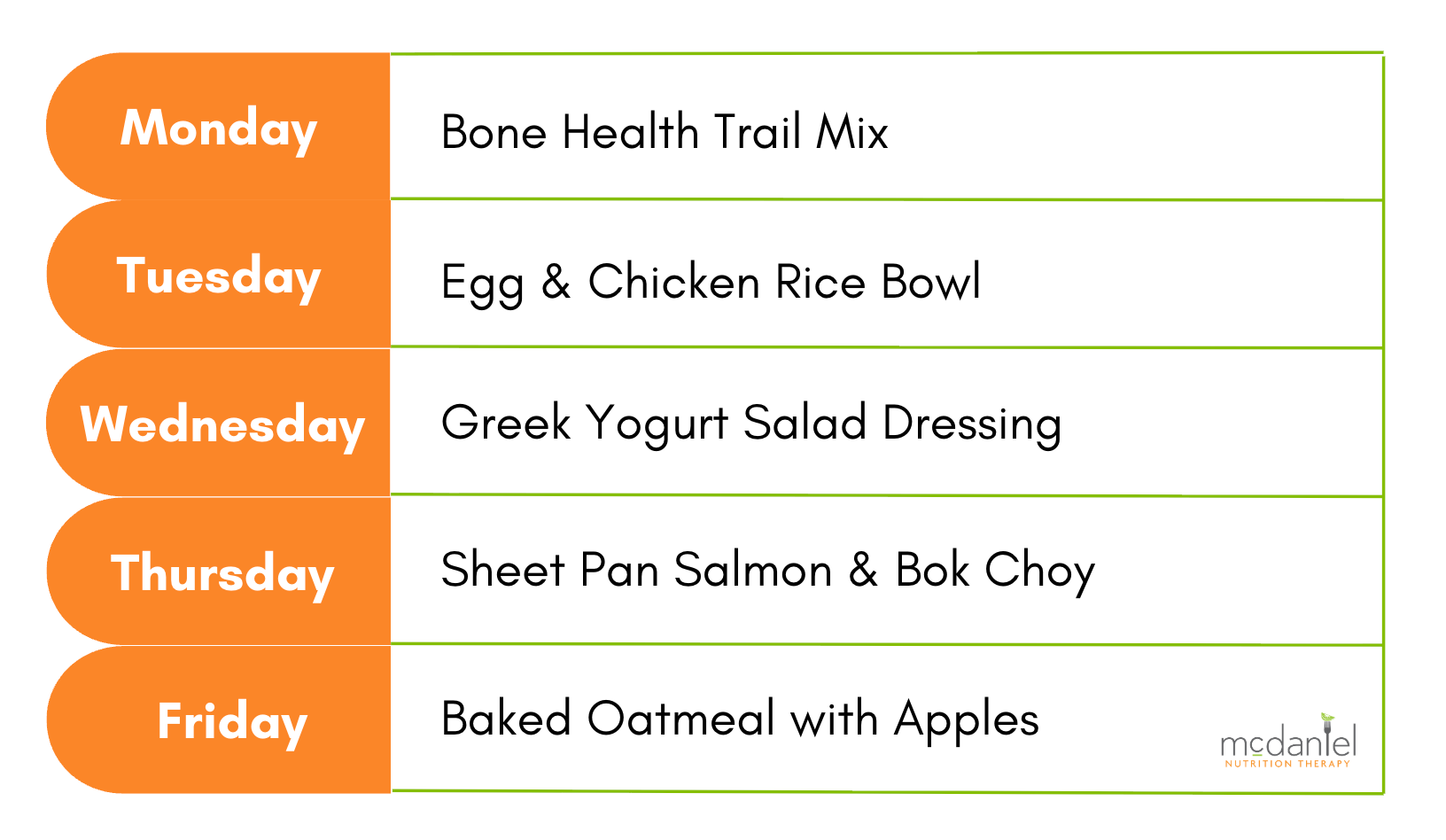
Menu for the Week of November 3-7th
Monday
Bone Health Trail Mix: Bone health ingredients include calcium-rich almonds and magnesium-packed pumpkin seeds + dried prunes to support bone density!

Tuesday
Egg & Chicken Rice Bowl: A protein-packed bowl paired with veggies to provide not just protein but also phosphorus and vitamin D for optimal bone strength.

Wednesday
Greek Yogurt Salad Dressing: Swap traditional creamy dressings for this calcium-rich version made with Greek yogurt.

Thursday
Sheet Pan Salmon & Bok Choy: Salmon is one of the best food sources of vitamin D and omega-3s which work together to strengthen bones and reduce inflammation. Paired with calcium-loaded bok choy!

Friday
Baked Oatmeal with Apples: This cozy breakfast or dessert brings together calcium-fortified oats and magnesium-packed nuts for bone-building support.

Happy Halloween, enjoy your favorite candy this evening!
Ha! I love this bone content today! Happy Halloween, dear Jen. 🎃