


It’s Heart Health Month, my favorite health-themed month of the year! And that is probably because it’s also quite “personal” for me. As I’ve shared before, heart disease runs strong in my family. That genetic backdrop has shaped both how I care for myself and how I show up professionally. I’m proactive about this stuff, not necessarily driven from fear anymore, but more from a place of curiosity and a desire to stay informed as the science evolves.

I’ve got a few posts on heart health already, so if you want to dig into those you can find them here and here. And this week, I’m offering a pause-and-check-in moment: a time to look at what we know, what we track, and what might be worth paying closer attention to!
Lifestyle Matters… and So Do Genetics
We often hear that around 80% of chronic disease, including heart disease, can be prevented or improved through lifestyle: how we eat, how we move, how we sleep, how we manage stress.
I largely believe that to be true.
And…we also know genetics matter. And heart disease is one of the places where genetic influence can be particularly strong.
That’s why, even though I probably didn’t need to see a cardiologist, I chose to meet with one over the past 2 years. Hey, if specialists exist, and you can get in, and insurance covers it, why not?
The Labs Worth Knowing (and Advocating For)
We can’t address something if we don’t know what’s going on…so regular cholesterol screening MATTERS.
Current guidelines recommend that adults begin routine cholesterol screening by age 20, with repeat testing every 4–6 years if risk is low. For those with additional risk factors, family history, metabolic conditions, perimenopause/menopause, or prior abnormal results, testing may be recommended more frequently.
Now, the next step might advocating for numbers that *might not be traditionally measured beyond the standard lipid panel.
There are a few markers that can add meaningful context, especially if you have a family history of heart disease.
Lipoprotein(a): A Big One
If you’ve ever wondered about your genetic risk, I strongly encourage checking lipoprotein(a), often written as Lp(a).
Lp(a) is a genetically determined lipoprotein that increases the risk of atherosclerosis, heart attack, and stroke. Unlike LDL cholesterol, Lp(a) levels are largely unaffected by diet, exercise, or weight loss. You inherit it, and you more or less keep it. (Like you could test your two-year old…and have an understanding of their genetic risk…)
In my own case, my LDL cholesterol hovered just above 100, not alarming. But my Lp(a) was VERY high.
Quick side note: What is LDL?
LDL stands for low-density lipoprotein. It’s often referred to as “bad cholesterol,” but that’s a bit of an oversimplification. LDL’s job is to carry cholesterol through the bloodstream so your body can use it to build cells and hormones. The issue isn’t LDL existing, it’s when too many LDL particles circulate in the blood, making it easier for cholesterol to deposit in artery walls and contribute to plaque buildup over time. That’s why both the amount of LDL and how it behaves in the body matter.
That information, about Lp(a), changed how I understood my personal risk.
One important nuance: Lp(a) can be measured in two different units, and interpretation depends on which one is used.
mg/dL (mass concentration)
nmol/L (particle number)
These are not directly interchangeable. In general:
An Lp(a) above 50 mg/dL or 125 nmol/L is considered elevated and associated with higher cardiovascular risk.
Because of this variability, it’s important that your provider knows which unit was used and interprets it accordingly. I actually had to call that out to my own doctor…
LDL and ApoB: Getting a Fuller Picture
At this point, I consider LDL cholesterol and Lp(a) two of the most important numbers to know for baseline risk, but they’re not the only ones that matter.
Other markers that help provide a fuller picture include:
ApoB (reflects the number of atherogenic particles)
Triglycerides
Non-HDL cholesterol
HDL cholesterol (still relevant, though no longer viewed in isolation)
ApoB can be helpful because it reflects the number of cholesterol-containing particles in the bloodstream, rather than just the amount of cholesterol they carry. In many people, LDL cholesterol and ApoB track closely together. But in some cases, they can differ. When they do, ApoB may provide additional context for understanding cardiovascular risk.
And just as important as a single snapshot? Trends over time.
When Bodies Change, Labs Change
I was reminded of this recently when meeting with a client whose cholesterol had been completely unremarkable, until she entered menopause. It strikes again! With declining estrogen (which plays a protective role in lipid metabolism), her LDL rose quickly (also…she has a strong genetic risk component, as well).
She didn’t do anything “wrong.” Her body changed! As they all do!
This is why context matters. Hormones fluctuate. Muscle mass changes. Metabolism shifts. Interpreting labs with that lens is an important piece of all of this.
Lifestyle, Medication, and Real-Life Tradeoffs
Once we understand your numbers, and how they’re trending, the next question often becomes: What do we do with this information?
For some people, lifestyle changes are enough. For others, medication becomes part of the conversation.
Statins, in particular, are among the most well-studied medications we have. They’re effective, widely prescribed, and have decades of safety data behind them.
Two years ago, I started Crestor (a statin). It was truly a choice as my overall risk profile is otherwise low. I eat well. I move regularly. I don’t smoke or drink. I’m not post-menopausal, yet.
In clinical practice, providers often use a 10-year ASCVD risk calculator, which considers age, cholesterol levels, blood pressure, smoking status, and diabetes history to estimate cardiovascular risk. These tools help guide, but not dictate, decisions.
Some people don’t feel good trying medication, and I fully respect that. What matters to me is understanding why we choose or avoid something:
Is it a belief?
A fear?
A desire to give lifestyle more time?
Or a quality-of-life consideration?
For me, the decision came down to this: the only way I could significantly lower my cholesterol without medication would be to eat in a way that wasn’t compatible with a life I actually want to live.
I follow a Mediterranean-style pattern most of the time. I also enjoy grilled cheese sandwiches pan-fried in butter, the occasional hot fudge sundae with pecans, and coconut curry dishes…Pleasure is important to me.
One More Tool to Consider: Calcium Scores
Another test that helped me contextualize risk was a coronary artery calcium (CAC) score.
A CAC scan looks for calcified plaque in the coronary arteries. It’s most useful for people who fall into a “gray zone,” those with genetic risk, mildly elevated LDL, or uncertainty about whether medication makes sense.
A score of zero can be reassuring. A higher score can support earlier or more aggressive prevention. It doesn’t replace labs, but it adds clarity!
The Big Picture
We do our best, and we also live real lives.
Heart health isn’t about perfection (what even is THAT?). It’s about paying attention, understanding your personal risk, and making choices that are both informed and sustainable.
Using February as a yearly check-in, to review labs, notice trends, and recalibrate if needed, feels like a grounded, compassionate way to approach it.
If heart health has been on your mind this month, I hope this gives you a few places to start.
And if you want help interpreting labs or deciding what your next step might be, you know where to find me!
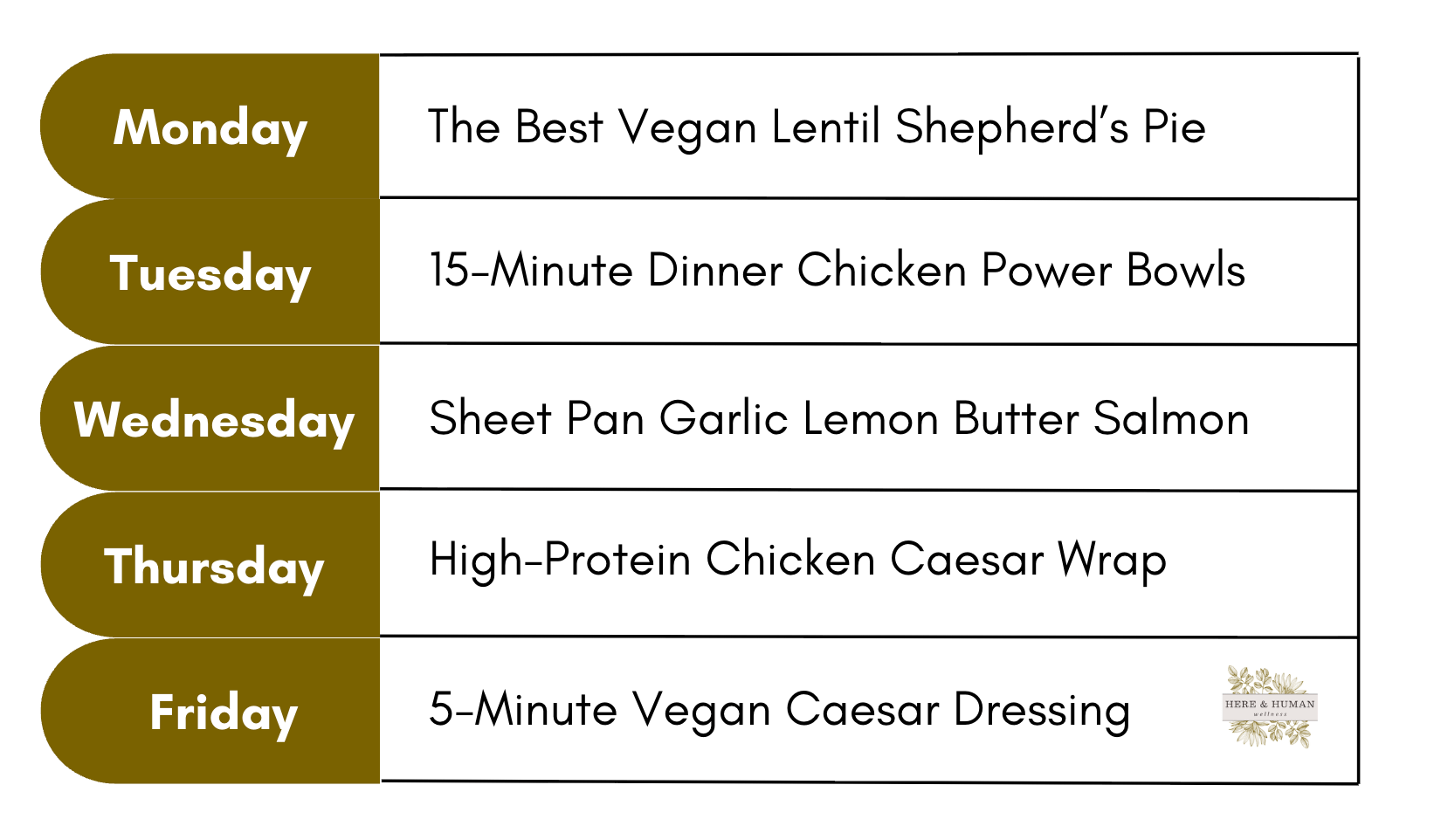
Menu for the Week of February 9-13th
Monday
The Best Vegan Lentil Shepherd’s Pie: I made this cozy dish last week when it was 8 degrees, and I VERY MUCH looked forward to lunch! Also, for my plant-based eaters, you might enjoy this ground beef substitute!

Tuesday
15-Minute Dinner Chicken Power Bowls: A great make-ahead option that comes together quickly and keeps you satisfied all the way to your afternoon snack.

Wednesday
Sheet Pan Garlic Lemon Butter Salmon: We try to do Salmon Sundays when we can, and this sheet-pan meal made it easy to cook the salmon alongside baby potatoes and vegetables all at once.

Thursday
High-Protein Chicken Caesar Wrap: These next two recipes go together. A simple, straightforward wrap paired with a really good dressing. If you eat chicken, no need to worry about whether the dressing is “vegan.” I don’t get too hung up on labels. It’s just easy and delicious on everything.this dressing was pretty dang easy and so delicious on everything!

Friday
5-Minute Vegan Caesar Dressing: See above :)

Happy almost Valentine’s Day, friends!
Everything looks amazing! Thank you for sharing :)